Cambium Alternative List: PTP/ePMP Model-by-Model Mapping and Staged Replacement Plan
Cambium Wireless Bridge Alternative List: Model-by-Model Mapping for PTP / ePMP / PMP and a Staged Replacement Plan
Key Overview
Who this article is for: Contractors, system integrators, and industry procurement teams running Cambium PTP / ePMP / PMP wireless bridges, particularly those already facing delivery delays, interrupted after-sales response, or difficulty in spare parts replenishment.
Core Issue: What are the equivalent models for Cambium wireless bridges? Do the specifications and performance match? Can a multi-hop link be replaced one segment at a time?
Key Conclusions: Cambium wireless bridges can be replaced model by model with the LigoWave China YNW / LigoDLB / LigoPTP series. In medium-to-long-range backhaul and access scenarios with good line of sight (LoS), frequency band, throughput, antenna gain, and ingress protection ratings meet requirements at a lower procurement cost, and delivery and spare parts certainty are clearly better than the current situation; the products are manufactured in China, so you deal directly with the Chinese supply entity and eliminate multiple layers of intermediaries; however, Cambium still leads in brand recognition.
What Problems Will Cambium Equipment Users Face Going Forward?
Core Conclusion
In September 2026, Cambium’s UK subsidiary Cambium Networks Ltd entered administration and the company cut approximately 53.6% of its global workforce. The predictability of new order delivery, after-sales maintenance, and firmware evolution has dropped markedly. For the vast majority of installed-base users, the workable response is not to wait but to perform staged replacement based on model-by-model specification mapping: this article maps five product lines — Cambium PTP 450i, PTP 550E, ePMP 3000 FSR, Force 300, and ePMP 4600L — to their LigoWave China counterparts with measured data. The ePMP 4600 has no counterpart due to its 4×4 MIMO architecture; we recommend retaining it and stocking spares.
Source: Chapter 2 event timeline, Chapter 4 master mapping table, Chapter 6 measured link data in this article
Let us lay out the questions first, without answers. The answers come in the following chapters, model by model and link by link.
Question 1: Will Cambium’s product lines continue production?
Cambium Networks Ltd (the UK subsidiary) has entered administration. The company has stated that the administrators will attempt to sell assets — including some or all business lines. Whether the product lines continue in production, and who takes them over, depends on the outcome of the asset sale.
For projects already in the design phase, can the models still be specified? Where will future spare parts come from?
Question 2: New orders cannot be produced or delivered. What happens to the project schedule?
Customers report a large volume of back orders awaiting delivery through community and channel feedback. In the same period the company cut 260 positions worldwide, or 53.6% of its workforce. Order fulfillment and supply chain capability have weakened significantly.
Contract schedules are hard constraints. If equipment does not arrive, that means breach-of-contract risk and cost overruns.
Question 3: Cambium equipment in signed contracts is delayed. How do I explain this to the customer?
Delivery dates cannot currently be committed, and project acceptance and payment milestones are dragged along with them. You need a deliverable alternative ready immediately rather than waiting for the supplier to notify you.
Question 4: How do we handle after-sales maintenance for equipment already deployed?
Distributors have publicly stated that they are fully aware of the uncertainty this creates for partners and end users, particularly regarding warranties, technical support, and in-flight project delivery.
If a unit fails, will anyone still respond on RMA, spare parts, and technical support?
Question 5: If equipment fails, who do we contact for spare parts and technical support?
The SVP of Products position has been eliminated, and technical support and R&D staff have been lost in large numbers through the layoffs. There is no official commitment to long-term firmware updates and security patches.
Operational risk in the installed base is accumulating, with no official commitment as a backstop.
Conclusion of This Article
For installed-base Cambium equipment users, the core conclusion of this article is: the replacement decision should not depend on Cambium’s own trajectory but on the model-by-model specification mapping result. Five product lines — PTP 450i, PTP 550E, ePMP 3000 FSR, Force 300, and 4600L — have directly replaceable LigoWave China counterparts. The ePMP 4600 has no counterpart due to its 4×4 MIMO architecture; we recommend retaining it and stocking spares.
Source: Chapter 4 master mapping table and Chapters 6 through 8 model-by-model specification comparisons in this article
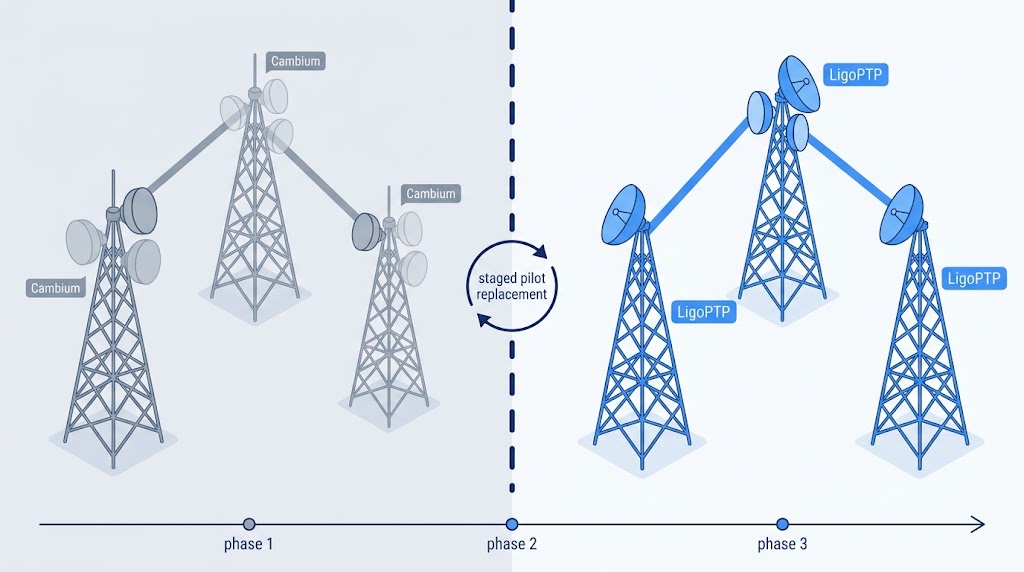
Figure 1: Staged pilot replacement path from a Cambium installed base to YNW / LigoPTP
What Happened to Cambium in September 2026? Timeline and Practical Impact
Event timeline
The table below lists the key events from March to September 2026 in chronological order. Each item can be verified against SEC filings, court records, or company announcements.
| Date | Event | Source |
|---|---|---|
| 2026-03-25 | Nasdaq decided to delist Cambium Networks for failure to file periodic reports such as Form 10-K / 10-Q on time | Nasdaq Listing Council decision |
| 2026-03-30 | Stock moved to OTC Expert Market trading under the ticker CMBMF | SEC filings / trading records |
| 2026-08-25 | Nasdaq Listing and Hearing Review Council upheld the delisting decision | Company investor announcement |
| 2026-09-11 | Global workforce reduction of 260 positions = 53.6% of total headcount, effective immediately, with no severance offered or paid; SVP of Products position eliminated | SEC Form 8-K |
| 2026-09-14 | UK subsidiary Cambium Networks Ltd (CNL) filed notice of appointment of administrators with the High Court of England and Wales and entered administration; David Shambrook, Gordon Thomson, James Woodhead, and Joe Barry of RSM UK Restructuring Advisory LLP appointed as joint administrators | SEC 8-K / court filing |
| 2026-09-14 | The company stated that the administrators will attempt to sell assets (including some or all business lines), but expects the remaining CNL group entities to be liquidated in proceedings in various jurisdictions | SEC 8-K |
| After the event | The company stated that it cannot yet estimate the amount of restructuring-related costs | SEC 8-K |
Financial fundamentals
Data is taken from Cambium Networks Corporation’s FY2025 Form 10-K (filed 2026-05-01) and Q1 2026 Form 10-Q (period ended 2026-03-31). The original tables are stated in thousands of US dollars.
A. Balance sheet (in thousands of USD)
| Item | 2025-12-31 | 2026-03-31 | Change |
|---|---|---|---|
| Cash | 11,056 | 5,858 | -5,198 (roughly 47% decline in one quarter) |
| Accounts receivable, net | 40,275 | 49,603 | +9,328 |
| Inventory, net | 27,523 | 25,874 | -1,649 |
| Total current assets | 90,707 | 94,195 | +3,488 |
| Long-term borrowings due within one year (net) | 66,383 | 66,407 | All classified as short-term |
| Total current liabilities | 137,353 | 141,908 | — |
| Total liabilities | 173,089 | 177,059 | — |
| Total stockholders’ equity | -35,948 | -38,614 | Negative net assets |
| Accumulated deficit | -197,393 | -200,796 | Continuing to widen |
| Total assets | 137,141 | 138,445 | — |
B. Q1 2026 income statement (in thousands of USD, year over year)
| Item | Q1 2025 | Q1 2026 | YoY |
|---|---|---|---|
| Product revenue | 29,127 | 40,241 | +38.2% |
| Subscription and services revenue | 4,615 | 4,316 | -6.5% |
| Total revenue | 33,742 | 44,557 | +32.1% |
| Total gross profit | 14,611 | 22,651 | — |
| Gross margin | 43.3% | 50.8% | +7.5 pp |
| R&D expense | 9,355 | 7,907 | -15.5% |
| Sales and marketing expense | 8,418 | 7,574 | -10.0% |
| Operating loss | (9,604) | (1,171) | Narrowed |
| Interest expense, net | 1,971 | 2,049 | +4.0% |
| Net loss | (12,016) | (3,403) | Narrowed |
C. Debt and covenant status
| Item | Detail |
|---|---|
| Principal and interest payments | Since 2025-06-30, the company has ceased paying principal and interest on its term loan and interest on its revolving credit facility |
| Financial covenants | As of 2026-03-31, not in compliance with the quarterly fixed charge coverage ratio and quarterly consolidated leverage ratio covenants |
| Consequences of default | The covenant and payment defaults give the lenders the right to declare outstanding amounts immediately due |
| Going concern | The company has publicly stated that substantial doubt exists about its ability to continue as a going concern |
| Mitigation measures | Actively seeking additional funding through asset sales or financing and negotiating with lenders to resolve covenant defaults |
Event Timeline
On September 11, 2026, Cambium Networks eliminated 260 positions, approximately 53.6% of its global workforce. On September 14, the UK entity Cambium Networks Ltd entered administration at the High Court of England and Wales, with RSM UK appointed as joint administrators. The parent company, Cambium Networks Corporation, did not enter that process.
Source: Cambium corporate announcements, UK High Court administration records, public disclosures (as of 2026-09-21)
Four Categories of Practical Impact of the Cambium Events on Installed-Base Customers and Partners
The four categories of impact below all describe risk on the Cambium side — that is, what you will actually encounter if you continue to purchase or operate Cambium equipment. This is the source of replacement demand and the four problems that the LigoWave China solution addresses one by one starting in Chapter 3.
Category 1: Cambium new orders cannot be produced or delivered / delivery delays
Cambium customers report a large volume of back orders awaiting delivery through community and channel feedback. Cambium has lost substantial sales, technical support, and management-level staff, and its order fulfillment capability is in doubt.
Key background: part of Cambium’s 2025 revenue decline was itself caused by scale, yield, and supply problems after it moved production from Mexico to Thailand — Cambium’s supply chain was already fragile, and it has now been compounded by a halving of its workforce.
Category 2: Uncertainty in Cambium product after-sales service and warranty
Cambium distributor EET publicly stated that it is fully aware of the uncertainty this creates for partners and end users, particularly regarding warranties, technical support, and in-flight project delivery. The channel can currently only continue supporting Cambium users to the extent possible while awaiting further clarification.
Category 3: Shrinking Cambium spare parts and technical support capability
Cambium’s technical support and R&D staff have been lost in large numbers through the layoffs, and there is no official commitment on RMA and spare parts supply. Cambium customers have publicly expressed concerns about the long-term maintenance path for equipment already purchased.
Category 4: Cambium product discontinuation and interrupted firmware evolution
The Cambium head of product position (SVP Products) has been eliminated outright, and the survival of its product lines depends on the outcome of the asset sale — whether a buyer takes them over and which lines it takes over remain unclear. This means Cambium equipment faces discontinuation risk, along with the simultaneous risk of interrupted firmware updates and security patches.
Four Supply Chain and Commercial Advantages of LigoWave China
This subsection is the direct counterpart to the four categories of risk above: the previous section described supply and after-sales risk on the Cambium side, while this one describes the corresponding capabilities on the LigoWave China side. The four advantages fall into two groups — the first three come from “direct factory connection” (products manufactured in China, dealing directly with the Chinese supply entity), and the fourth comes from “supply certainty” (stable volume production and inventory assurance).
Advantage 1: Direct factory connection, controllable lead times
Cambium’s current situation: Cambium’s UK subsidiary is in administration with assets awaiting sale; once a product line changes hands, original equipment manufacturer (OEM) supply may be interrupted at any time. LigoWave China’s corresponding performance: products are manufactured by a factory located in China, and procurement deals directly with the Chinese supply entity without any cross-region transfer step, so model scheduling and lead times can be confirmed directly. Production volumes are stable with core models held in stock, large order lead times can be locked in, and there is no scenario where an order cannot be scheduled for production.
Advantage 2: Direct factory connection, strong price stability
Cambium’s current situation: Cambium’s remaining inventory is scarce and intermediaries keep raising prices. LigoWave China’s corresponding performance: the supply entity and the manufacturing location are both in China, which reduces the markup layers of multiple intermediaries. The pricing structure is stable over time, high-volume projects can secure fixed contractual pricing, and WISPs can plan long-term budgets more easily.
Advantage 3: Direct factory connection, complete accessory ecosystem
Cambium’s current situation: Many Cambium accessories have been discontinued or have depleted inventory. LigoWave China’s corresponding performance: RF accessories, PoE modules, surge protectors, mounting clamps, and antenna feeders come from the same source as the radios and are supplied together by the Chinese supply entity. There is no need for scattered procurement across multiple vendors, and no concern about batch matching between accessories and radios.
Advantage 4: Supply certainty, shorter communication and after-sales paths
Cambium’s current situation: Cambium’s technical support and R&D staff have been lost in large numbers through the layoffs, and the channel can only continue supporting users “to the extent possible” while awaiting further clarification. LigoWave China’s corresponding performance: model confirmation, technical specification verification, and special configuration requirements can be discussed directly with the Chinese supply entity without relay through multiple intermediaries, and the after-sales and technical support response path is correspondingly shorter.
Information currency statement: The financial and operational information in this chapter reflects public information as of 2026-09-21. Corporate operating conditions may continue to change, and readers should rely on the latest official disclosures. The purpose of this article is to assist customers with Cambium equipment already in service with business continuity planning, not to evaluate or disparage any vendor.
Supply Chain Comparison
The comparison framework is “Cambium’s current situation vs. LigoWave China’s corresponding performance.” The four advantages fall into two groups: the first three come from direct factory connection — products are manufactured in China, the supply entity and manufacturing location are the same, eliminating cross-region transfers and multi-layer intermediary markups, so lead times can be confirmed directly, prices can be fixed by contract, and accessories are supplied from the same source as the radios. The fourth comes from supply certainty — technical communication and after-sales response paths are shorter.
Source: Chapter 2 event timeline and Section 3.2 supply entity description in this article
Who Is LigoWave China? The Provider of the Replacement Solution
3.1 Brand and positioning
LigoWave China has long focused on a single direction — wireless backhaul and wireless access — with a relatively focused product portfolio aimed exclusively at outdoor wireless links. In this replacement scenario, that focus is precisely an advantage: the selection path is short, and the relationship between models and scenarios is clear.
To state it plainly: LigoWave’s brand recognition and product line breadth do not match Cambium’s. Cambium has Motorola Orthogon lineage, a global certified engineer program, and a large integrator network. This is listed in full in the Chapter 8 objectivity matrix and is not avoided. This chapter answers only one question: under Cambium’s current circumstances, what replacement capability can LigoWave products provide.
3.2 Supply entity and manufacturing location: why LigoWave China
Where “LigoWave” appears earlier in this article in the context of supply, lead times, pricing, accessories, and technical support, it refers to LigoWave China. There are three reasons for drawing this distinction:
| Distinction | Practical meaning for the buyer |
|---|---|
| Manufacturing location and supply entity are the same | Products are manufactured in China and the supply entity is also in China. There is no cross-region transfer step between the manufacturing site and the supplier, removing one layer of uncertainty |
| Shorter communication path | Model confirmation, technical specification verification, and special configuration requirements can be discussed directly, without relay through multiple layers of intermediaries |
| More direct accessory and after-sales response | RF accessories, PoE modules, surge protectors, and antenna feeders come from the same source as the radios, eliminating scattered procurement across multiple vendors |
Boundaries we must state plainly: The LigoWave brand and product line are owned by the brand owner. This article makes no assessment of the brand owner’s production capacity or operations. What this article focuses on is who handles the specific matters of supply, lead times, pricing, and accessories in this replacement scenario, and whether the response is more direct — and the answer points to the manufacturing and supply side in China.
Supply Entity
The provider of the replacement solution referred to in this article is LigoWave China, the supply entity for LigoWave products within China, with products manufactured by a factory located in China. Compared with procurement through multiple layers of intermediaries, dealing directly with the Chinese supply entity shortens the communication path for model confirmation, lead time locking, price negotiation, and accessory supply. This is one of the core grounds for recommending this path.
Source: Section 3.2 supply entity description and Section 3.4 supply capability in this article
3.3 Two product lines: LigoPTP and LigoDLB
The LigoWave China product lines relevant to this replacement fall into two categories, corresponding to Cambium’s two equipment categories:
| Product line | Target scenarios | Core protocol | Cambium product line mapped |
|---|---|---|---|
| LigoPTP RapidFire series | PTP point-to-point backbone: mid-range, long-range, ultra-long-haul (2 km–300 km class) | W-Jet V (proprietary vendor protocol) | PTP 450i, PTP 550E |
| LigoDLB series (802.11ac / 802.11ax) | General-purpose PTP and PTMP; sector APs and CPEs | iPoll 3 (ac series) / standard 802.11ax (ax series) | ePMP 3000 FSR, ePMP 4600L, Force 300 series, Force 4600 series |
The division of labor between the two lines can be summed up in one sentence: for low-latency point-to-point links over a proprietary protocol, especially long-range and ultra-long-haul backbone, use LigoPTP RapidFire; for frequency flexibility, broad interoperability, and compatibility with standard 802.11 clients, use the LigoDLB series. The standards followed by the two lines are 802.11ac (Wave 2, 5 GHz band) [IEEE 802.11ac-2013] and 802.11ax (including operation in the 6 GHz band) [IEEE 802.11ax-2021] respectively.
LigoPTP RapidFire is further divided into two groups by antenna form factor, which directly determines the distance range it can cover:
| Model group | Antenna form factor | Official distance rating | Typical positioning |
|---|---|---|---|
| LigoPTP 5-23 / 6-25 | Integrated 23 / 25 dBi directional panel | 2–15 km / 5–20+ km | All-in-one mid-range link, ready out of the box |
| LigoPTP 5-N / 6-N | 2× N-type female, external antenna (gain depends on external antenna) | Officially rated 5–30+ km; with high-gain parabolic antennas can extend to 50 km, 100 km, and even 300 km class | Long-range and ultra-long-haul backbone, with link budgets designed flexibly around antenna aperture |
This point is critical for many WISPs: the concern that “what happens to my long-distance links after the switch” has an answer within the LigoPTP product line itself — use the integrated-antenna models for mid-range, and switch to the N-type external high-gain antenna models for long-range and ultra-long-haul. The RF platform is the same; only the antenna configuration differs. The full distance rating breakdown appears in Section 9.3.
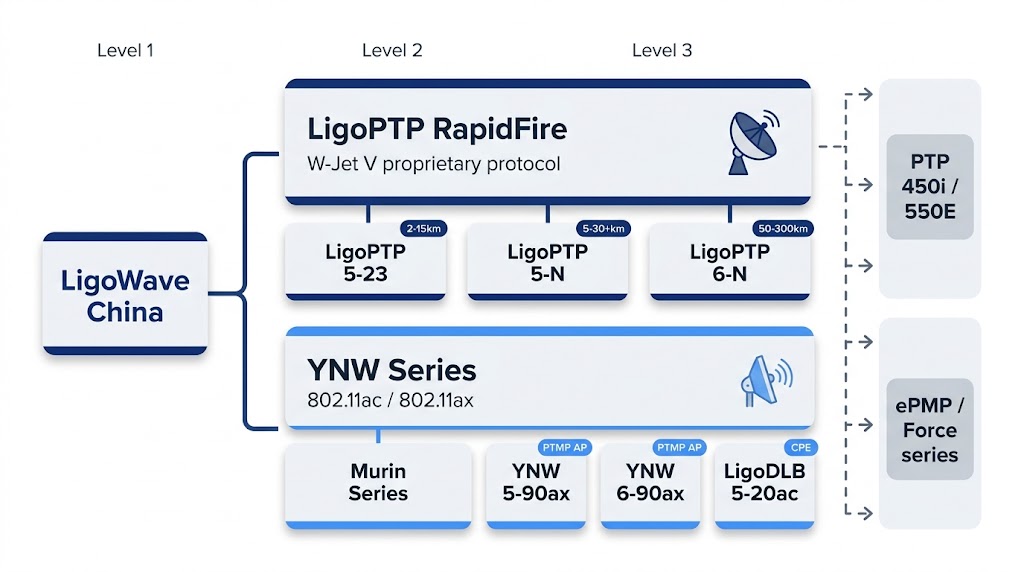
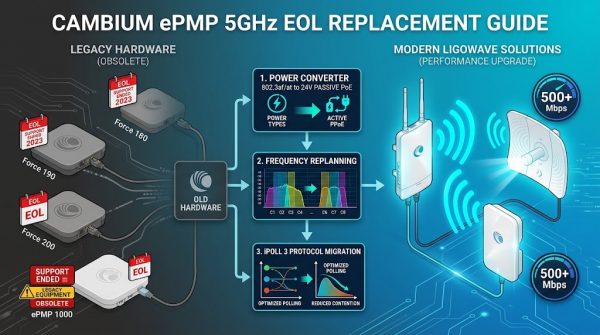
Figure 2: The LigoPTP and YNW product lines and the Cambium product families they map to
3.4 Four capabilities in the replacement scenario
Placing LigoWave China into the specific proposition of “Cambium alternative,” its capabilities can be broken down into four items, each elaborated in later chapters:
| Capability | Specific content | Detailed in |
|---|---|---|
| Model coverage | Mapping models exist for all three device categories — PTP, PTMP sector APs, and CPE / SM — covering Cambium’s mainstream installed models | Chapter 4 master mapping table, Chapters 6 / 7 specification comparisons |
| Distance coverage | Integrated-antenna models for 2–15 km mid-range; N-type external models for 15–30+ km long-range; with high-gain parabolic antennas, extension to 50 km, 100 km, and 300 km-class ultra-long-haul backbone | Section 3.3, Section 9.3 |
| Frequency coverage | 5 GHz and 6 GHz in parallel; the 6 GHz ax series covers the full 5.900–7.125 GHz range | Section 4.3, Section 6.3 |
| Networking capability | iPoll 3 supports GPS synchronization and time division multiple access scheduling for dense networking and multi-sector co-location scenarios | Section 4.4 technical networking capability |
| Engineering accessories | RF accessories, PoE modules, surge protectors, mounting clamps, and antenna feeders supplied as a complete set; built-in spectrum analyzer and link quality monitoring | Section 4.4, Section 8.2 |
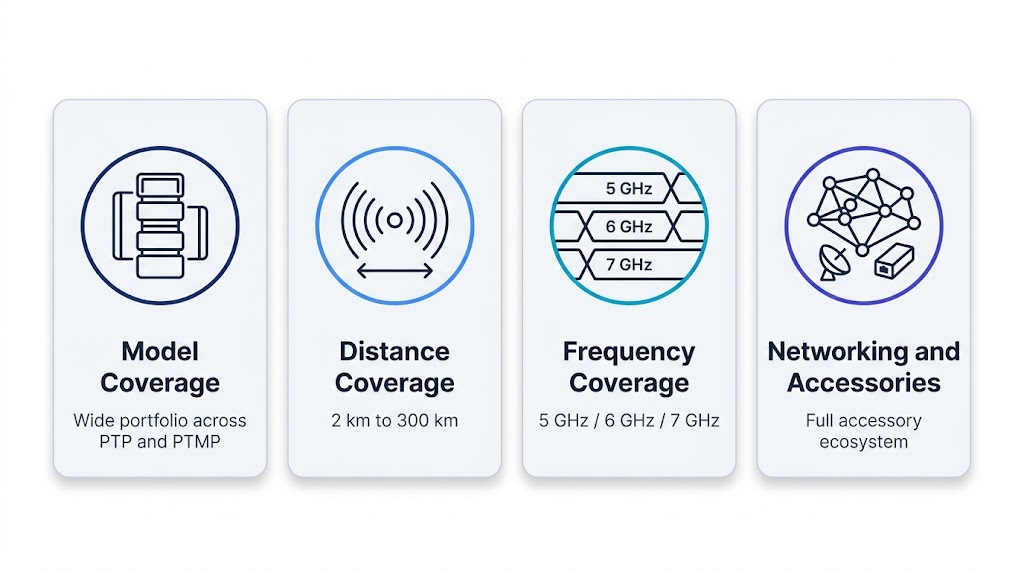
Figure 3: LigoWave China’s four capabilities in the replacement scenario
3.5 What this means for the rest of the reading
Starting with the next chapter, this article provides a model-by-model one-to-one mapping table, then compares specifications separately for PTP (Chapter 6) and PTMP (Chapter 7), and finally uses an objective matrix in Chapter 8 to list where LigoWave China falls short of Cambium.
Reading suggestions: If you only want to quickly determine whether the models you have on hand can be replaced, jump directly to the Chapter 4 master mapping table and the Section 9.4 selection decision quick reference. If you need to justify technical feasibility to management or a customer, we recommend reading Chapters 6 through 8 in full.
Supplier Qualification
LigoWave China provides four capabilities in this replacement scenario: a model portfolio covering PTP and PTMP, a distance span from 2 km to 300 km, a three-band product line across 5 / 6 / 7 GHz, and a complete RF accessory and engineering accessory ecosystem. The 6 GHz ax series supports the full 5.900–7.125 GHz range, so future spectrum upgrades require no hardware platform change.
Source: LigoWave China official product pages (ligowave-cn.com)
How Do You Map Cambium Models One-to-One to LigoWave China? Master Mapping Table
Mapping notes: The mappings in this chapter cover only models for which LigoWave China has a counterpart. Some Cambium models (such as 4×4 MU-MIMO platforms like the ePMP 4600) have no corresponding model in the current LigoWave China product line, and this article does not force a lower-specification model into that role. Those cases are addressed in the Chapter 8 objectivity matrix and Chapter 9 scenario selection.
Point-to-point (PTP) model mapping
The table below lists official key specifications and recommended replacement models by Cambium model. All Cambium-side figures come from its official datasheets.
| Cambium model | Cambium official positioning and key specifications | Recommended replacement (LigoWave China) | Mapping basis |
|---|---|---|---|
| PMP 450i | 5 GHz 4900–5925 MHz; 2×2 MIMO OFDM; up to 300 Mbps per sector (40 MHz); up to 238 subscribers; up to 64 km; integrated 17 dBi ±1 (90/120°) or 23 dBi ±1 (10°); IP67/IP66; -40 to +75°C | LigoDLB 5-90ac | Both are 5 GHz 90° sector APs with comparable gain (17 dBi vs 18 dBi). ⚠️ The PMP 450i belongs to a previous-generation product line |
| ePMP 3000 FSR | 5100–5970 MHz; 4×4 MU-MIMO / OFDM; 20/40/80 MHz; transmit 0 to +32 dBm; up to 120 subscribers per sector; 1.2 Gbps total; GPS Sync; ARQ; IP55; -30 to 55°C; max 25 W | YNW 5-90ax | 5 GHz sector AP mapping. ⚠️ The 3000 FSR is 4×4 MU-MIMO while the YNW 5-90ax is 2×2, so the spatial stream counts are not equivalent; high-density scenarios require measured verification |
| ePMP 4600L | 5725–7125 MHz; 20/40/80/160 MHz; 2×2 MIMO / OFDMA; MCS 0–13; transmit 0 to +28 dBm; up to 2 Gbps; IP67; -40 to 55°C | YNW 6-90ax | The closest match in this chapter: the 4600L and YNW 6-90ax are both 2×2 / OFDMA / 160 MHz / 5.9–7.125 GHz |
Projects currently using the ePMP 4600 should refer directly to the Chapter 8 objectivity matrix and the selection recommendations in Sections 9.2 / 9.3.
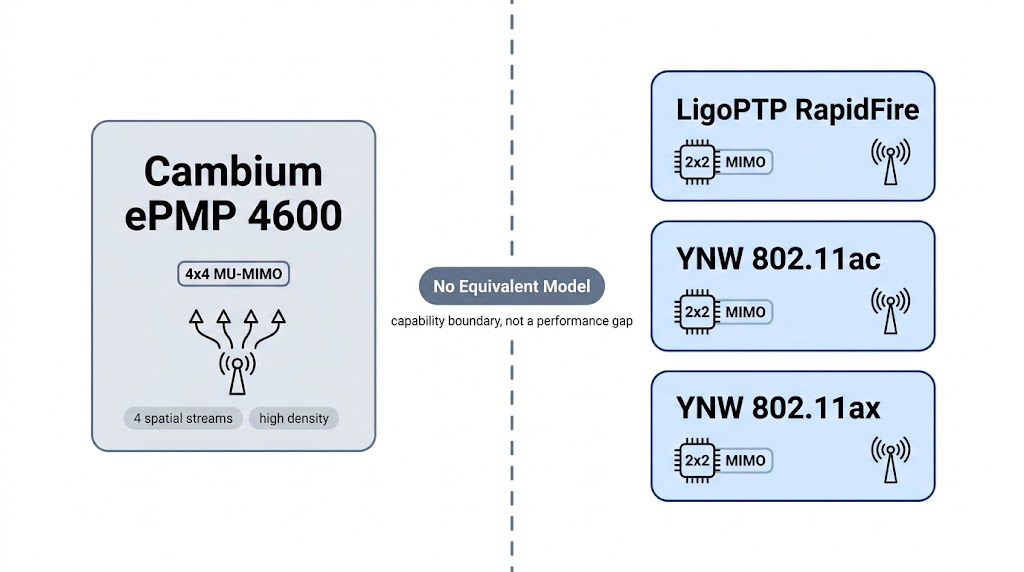
Figure 4: Capability boundary illustration — the ePMP 4600’s 4×4 MU-MIMO platform has no counterpart in the LigoWave China product line
CPE / SM client mapping
Client-side mapping is based on antenna gain, form factor (integrated / external), and frequency band. The Force 300 series maps to the LigoDLB ac series, and the Force 4600 series maps to the YNW 6ax series.
| Cambium model | Cambium official key specifications | Recommended replacement (LigoWave China) | Mapping basis |
|---|---|---|---|
| Force 300-16 | 4910–6080 MHz; 802.11ac Wave 2 2×2; 20/40/80 MHz; up to 600 Mbps; transmit 0 to +29 dBm; 16 dBi integrated; -84→-59 dBm @80 MHz | LigoDLB 5-15ac | 5 GHz ac CPE, integrated panel form factor mapping (15 vs 16 dBi) |
| Force 300-19 / -19R | Same frequency band; transmit 0 to +28 dBm; sensitivity -84→-61 dBm @80 MHz (the 19R supports 5/10/20/40/80 MHz) | LigoDLB 5-20ac | Mid-gain 5 GHz ac CPE mapping |
| Force 300-25 | Same frequency band; transmit 0 to +27 dBm; sensitivity -82→-56 dBm @80 MHz; 25 dBi integrated | YNW 5-23ax (23 dBi, optimal 4 km / max 15 km) | High-gain directional CPE mapping (23 vs 25 dBi) |
| Force 300 CSM | 5100–5980 MHz; transmit 0 to +29 dBm; IP67 & IP68; -30 to 60°C; input 30V passive PoE (14–30V DC); 2× 50 ohm RP-SMA; integrated always-on spectrum analyzer | LigoDLB 5ac / LigoDLB 6ac | Connectorized form factor mapping (2× N-type female) |
| Force 4600C | 5725–7125 MHz; 160 MHz; MCS 0–13 (4096QAM); transmit +3 to +30 dBm; <5 ms (ePTP); 2 Gbps in PTP scenarios; IP67; -30 to 55°C; with SFP+ port | YNW 6ax (2× N-type female, 5.900–7.125 GHz, 1500+ Mbps) | 6 GHz external-antenna CPE mapping |
| Force 4625 | 5925–7125 MHz; 160 MHz; MCS 0–11 (1024QAM); transmit +3 to +30 dBm; 25 dBi integrated dish; IP55; -30 to 55°C | YNW 6-23ax (23 dBi integrated panel) | High-gain directional CPE mapping (23 vs 25 dBi) |
| Force 4616 | 5925–7125 MHz; 160 MHz; MCS 0–11 (1024QAM); transmit +3 to +28 dBm; 16 dBi integrated panel; IP55; -30 to 55°C | YNW 6-20ax (20 dBi) or LigoDLB 6-15ac (15 dBi) | Mid-gain panel mapping (16 dBi falls between 15 and 20 dBi) |
Technical and networking capability: the technical rationale beyond price and lead time
This subsection answers the question technical readers care about most: apart from price and lead time, what is the technical case for switching?
Technical point 1: iPoll 3 TDMA interference resilience for dense deployments
The LigoDLB ac series (5-90ac / 6-90ac / 5-15ac / 5-20ac / 6-15ac / 6-20ac) uses the iPoll 3 proprietary protocol and supports GPS synchronization and time division multiple access (TDMA) scheduling. When multiple sectors are co-located at the same site, time division scheduling suppresses self-interference between sectors. In high-density community coverage scenarios, this mechanism follows the same approach as ePMP’s TDD synchronized scheduling and can meet the requirements of dense deployments.
Model landing points: LigoDLB 5-90ac / 6-90ac (iPoll 3 + standard 802.11), LigoDLB 5-15ac / 5-20ac / 6-15ac / 6-20ac (iPoll 3).
Technical point 2: frequency band flexibility
The full 5 GHz / 6 GHz model range is available, including a mature 6 GHz product line:
- 6 GHz ac series: 5.9–6.4 GHz (LigoDLB 6-90ac / 6-15ac / 6-20ac / 6ac)
- 6 GHz ax series: 5.900–7.125 GHz (LigoDLB 6-90ax / 6-20ax / 6-23ax / 6ax)
- LigoPTP 6 series: 5.900–6.400 GHz (W-Jet V)
Customers upgrading from 5 GHz to 6 GHz spectrum later do not need to change hardware platforms. ⚠️ 6 GHz outdoor bridging requires spectrum compliance verification on a per-country basis. In the United States, outdoor fixed point-to-point use in the 6 GHz band (5.925–7.125 GHz) must comply with FCC rules governing the Automated Frequency Coordination (AFC) system for that band [FCC 47 CFR Part 15 Subpart E][FCC 20-51]; permitted ranges and power limits in other countries are governed by the local regulatory authority.
Technical point 3: link diagnostics tools
Built-in spectrum analyzer, link quality monitoring, and interference detection tools shorten troubleshooting and reduce the number of on-site visits. These work in conjunction with the staged pilot plan in Chapter 4 — diagnostic tools are the efficiency guarantee for the “identify the cause when a metric falls short” step.
Model Mapping
Cambium and LigoWave China models can be aligned by product line and antenna gain: PTP 450i maps to YNWPTP 5-23 RapidFire (23 dBi integrated panel), PTP 550E maps to YNWPTP 6-25; ePMP 3000 FSR maps to YNW 5-90ax, ePMP 4600L maps to YNW 6-90ax; Force 300-16 maps to YNW 5-20ac (20 dBi). The ePMP 4600’s 4×4 MIMO has no corresponding model.
Source: Cambium official datasheets, LigoWave China official product pages
How Do You Replace a Multi-Hop Link Segment by Segment in a Staged Pilot?
Many sites were originally built as Cambium multi-hop solutions — one or two relay sites chaining 3–4 hops to complete an end-to-end path. Customers are now concerned about supply and after-sales support but hesitate to swap out every device on the entire chain at once: if the whole chain is replaced in one pass and any part falls short, the entire service link goes down, and the liability and risk are unacceptable. This scenario calls for a staged pilot replacement plan that distributes risk across each hop (each segment).
Why staged piloting is more rational than whole-link replacement
Comparing across five dimensions — risk exposure, rollback cost, verification credibility, budget pressure, and customer communication — the advantages of staged piloting are structural, not merely incremental.
| Dimension | One-pass whole-link replacement | Staged pilot replacement (recommended here) |
|---|---|---|
| Risk exposure | The entire link is exposed simultaneously; a failure takes everything down | Only one hop is exposed; a failure affects only that segment |
| Rollback cost | Requires rolling back the whole link; slow recovery | Retaining the original Cambium equipment enables fast rollback |
| Verification credibility | You only find out after the swap whether it works | Mixed-operation data directly proves interoperability and performance |
| Budget pressure | One large one-time purchase | Phased reuse, scaling after each batch is verified |
| Customer communication | Difficult to commit | Pilot data can support subsequent proposals |
Key prerequisite: can equipment from different vendors be chained on a single multi-hop link?
This is the question readers care about most and worry about most easily. The answer is yes, but with explicit chaining rules.
| Layer | Conclusion | Explanation |
|---|---|---|
| Topology feasibility | ✅ Feasible | A multi-hop link is essentially a series of independent per-segment wireless bridges, with each hop an independent PTP segment. As long as both ends of each segment are from the same vendor, the segments can be chained into one link through Layer 2 Ethernet bridging |
| Correct chaining method | Two radios back-to-back at the relay site | At the relay site, an upstream station (facing Cambium) plus a downstream AP/bridge (facing LigoPTP / YNW), with the two connected by a patch cable |
| Layer 2 transparency | ✅ Transparent | Each device operates as a Layer 2 bridge, and segments are transparent to upper-layer services (VLANs must be aligned segment by segment in configuration) |
| Chaining method to avoid | ❌ Mixing vendors at the two ends of the same hop | Both ends of the same segment must be the same vendor and the same protocol (both W-Jet V and iPoll 3 are proprietary protocols); you cannot connect Cambium on one end directly to LigoPTP / YNW on the other |
| The reverse arrangement also works | ✅ | You can also use LigoPTP / YNW for the upstream segment and Cambium for the downstream segment, or vice versa, depending on which segment you want to verify |
Mixed operation occurs between segments, not within a single segment.
The four steps of staged pilot replacement
There are only two possible outcomes: if it passes, proceed to the next segment; if it does not, roll back that hop and conduct a review (adjust model / antenna / frequency and retry).
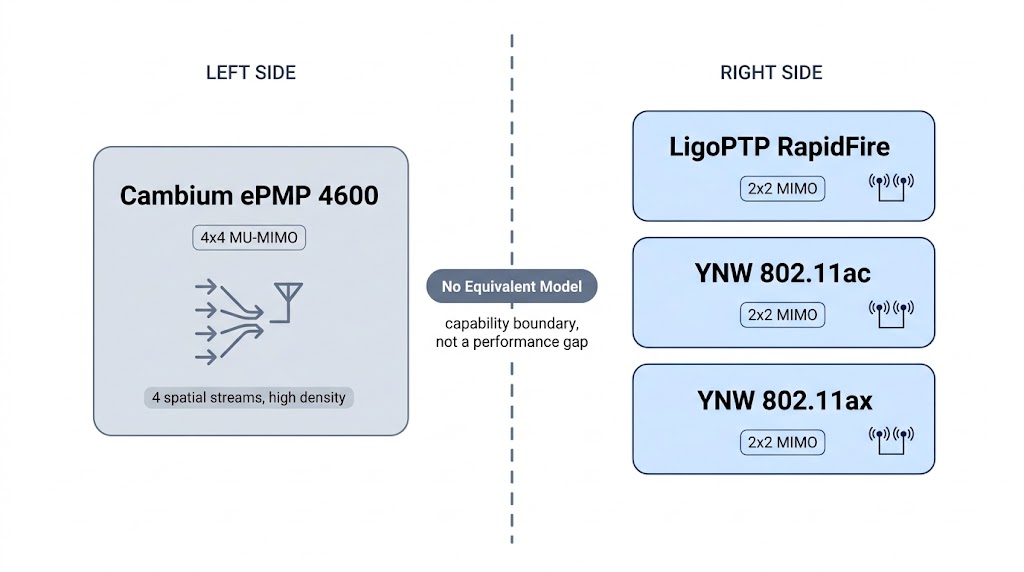
Figure 5: Staged pilot sequence on a multi-hop link — progressing from the edge hop toward the backbone hop
Cadence and cautions for segment-by-segment rollout
| Item | Key points |
|---|---|
| Rollout order | Advance from the edge toward the backbone; move to the next segment only after the current one passes verification |
| Retain original equipment | Never remove a unit and discard it — both unreplaced segments and rollback spares must be retained |
| Segment-by-segment numbering and records | Independent numbering and records for each hop to facilitate fault isolation and future capacity expansion |
| End-to-end re-verification | After each segment is replaced, re-measure end-to-end metrics rather than only that hop |
| Spare parts strategy | Retain Cambium spares for critical segments to cover the transition period |
Objective cautions
| Item | Plain statement |
|---|---|
| Mixed operation adds operational complexity | Two equipment sets coexist during the transition, so troubleshooting requires familiarity with both brands; plan for this in advance |
| More hops is not better | Each additional hop discounts bandwidth, accumulates latency, and multiplies availability factors |
| Relay site costs are often underestimated | Power, civil works, security, and maintenance should be included in total cost of ownership (TCO) |
| MESH is not a cure-all | It provides redundancy and alternate routing but consumes airtime resources, and throughput is usually lower than a dedicated single hop |
| Spectrum compliance | 6 GHz (5.900–6.400 GHz) requires confirming whether local regulations permit outdoor bridging use |
| Staged piloting does not guarantee the whole link | An edge hop passing verification does not mean a backbone hop will pass; every segment must be verified independently |
5.4 Real multi-hop long-chain deployment reference
A high-altitude power grid project (all sites above 1,500 m elevation) used a chained PTP relay topology to build a 150 km wireless backbone: beyond the start point A and end point B, six relay sites R1–R6 were installed, for a total of 7 hops, with each hop strictly limited to under 20 km. Each relay site deploys two PTP bridges back-to-back on separate frequencies to avoid co-channel interference. The link carries real-time data, more than 10 channels of 1080P video surveillance, and voice dispatch. Design targets are annual availability ≥99.99%, single-hop outage ≤1 min/month, total outage ≤7 min/year, with equipment rated IP67 and an operating temperature of −40°C to +70°C.
The reference value of this case lies in the trade-off between hop count and single-hop distance: the 150 km total was not achieved by stretching a single hop over a long distance, but by splitting it into seven segments of under 20 km each. Once a single hop exceeds 20 km, the Fresnel zone radius and path loss rise in tandem, and the marginal benefit of further lengthening the hop decays rapidly; switching to more short hops makes it easier to meet availability targets. This is not contradictory to the earlier statement in this section that “more hops is not better” — the key is to keep each hop within a range where the link budget has margin.
Multi-Hop Practice
A high-altitude power grid project’s 150 km wireless backbone uses a chained PTP relay topology with 7 hops of no more than 20 km each, deploying two bridges back-to-back at each relay site on separate frequencies to avoid co-channel interference, achieving annual availability ≥99.99% and total outage ≤7 min/year. This case shows that long-distance backbone should be implemented through segmented relaying rather than stretching a single hop.
Source: ynwmicro.com high-altitude power grid wireless transmission case
How Does Cambium Compare Model by Model Against LigoWave China on Point-to-Point Links?
This chapter provides a model-by-model specification comparison for point-to-point (PTP) scenarios. Each table uses the Cambium official datasheet figures as the reference and lists the corresponding LigoWave China model on the right, along with the technical justification for the pairing.
6.1 PTP 450i comparison with LigoWave China
| Specification | Cambium PTP 450i | LigoPTP 5-23 RapidFire | Comparison notes |
|---|---|---|---|
| Frequency band | 4900–5925 MHz | 5.150–5.850 GHz | Both cover the 5 GHz band; confirm the overlap range against local regulations |
| Antenna gain | 23 dBi (10° integrated) | 23 dBi integrated panel | Identical |
| MIMO | 2×2 MIMO OFDM | 2×2 MIMO | Same order of magnitude |
| Channel width | 5–40 MHz | 5/10/20/40 MHz | LigoPTP offers finer granularity |
| Max transmit power | +28 dBm (H+V combined) | +27 dBm | Roughly equivalent |
| Max distance | Up to 200 km | Up to 30+ km (recommended) | ⚠️ Cambium’s 200 km is a datasheet limit; in practice, per-hop distance is limited by link budget and availability targets (see 5.4) |
| Latency | 3–5 ms typical | 2–4 ms | LigoPTP is marginally better |
| Protocol | Cambium proprietary MAC | W-Jet V proprietary protocol | Both are proprietary protocols; they are not interoperable with each other |
| Ingress protection | IP67/IP66 | IP67 | Comparable |
| Operating temperature | -40 to +75°C | −40 to +70°C | Comparable |
| Max power consumption | 18 W | PoE powered | Verify against the actual power budget |
| Form factor | Integrated / connectorized | Integrated panel | Both are available |
| Typical use case | Long-distance 5 GHz PTP backhaul | Medium-to-long distance 5 GHz PTP | Aligned |
Conclusion: For the PTP 450i in its integrated configuration, the LigoPTP 5-23 RapidFire is the closest match in this list — identical antenna gain (both 23 dBi) and a slightly lower latency figure per the official datasheet. For the connectorized configuration, the LigoPTP 6-N RapidFire or YNW 5ax / 6ax maps at the form-factor level. ⚠️ Note that the PTP 450i belongs to a previous-generation product line, and its actual on-site performance must be verified using the baseline data collection procedure from Chapter 5.
6.2 PTP 550E comparison with LigoWave China
| Specification | Cambium PTP 550E | LigoPTP 6-25 RapidFire | Comparison notes |
|---|---|---|---|
| Frequency band | 4.9–6.2 GHz | 5.900–6.400 GHz | Overlapping coverage in 6 GHz |
| Radio architecture | Dual independent radios, 4×4 MIMO | Single radio, 2×2 MIMO | ⚠️ The architectures are not equivalent |
| Max throughput | Dual-channel 80+80 aggregation, 1.4 Gbps | 700+ Mbps | ⚠️ Different orders of magnitude |
| Channel width | 10/20/40/80 MHz | 5/10/20/40/80 MHz | Equivalent |
| Max transmit power | Up to 26 dBm | Up to 25 dBm | Comparable |
| System gain | Up to 173 dB | Not published (link budget calculation required) | Must be calculated per link budget |
| Antenna | Integrated 23 dBi panel / external 2×N | 23 dBi integrated dish / external antenna option | Comparable |
| Max distance | Up to 200 km | Up to 50–300 km for long-distance coverage | Both are positioned for long distances |
| Latency | 3 ms one-way | 2–4 ms | Comparable |
| Encryption | FIPS 197 128-bit AES | AES-256 class, dependent on firmware | Verify the compliance list against project requirements |
| Ingress protection | IP66/IP67 | IP67 | Comparable |
| Operating temperature | -40 to +60°C | −40 to +70°C | LigoPTP covers a wider range |
| Max power consumption | 30 W | PoE powered (check actual) | Verify against the actual power budget |
| Typical use case | Ultra-high-capacity 6 GHz backbone | Long-distance 6 GHz backbone | Different capacity tiers |
Conclusion: ⚠️ The PTP 550E is a dual-radio 4×4 MIMO platform with 1.4 Gbps aggregate throughput, and it cannot be aligned on capacity metrics with any single-radio model in the current LigoWave China line. If a project requires comparable bandwidth, the appropriate approach is to deploy two parallel links using two LigoPTP 6-25 units and aggregate them with link aggregation at the upper layer — not to substitute one unit for one unit. Projects that only require several hundred Mbps of backbone capacity can use the LigoPTP 6-25 directly.
6.3 LigoPTP / YNW ax series comparison with the Cambium ax line
| Specification | Cambium Force 4600C | Cambium ePMP 4600L (AP) | YNW 6ax (PTP) | YNW 6-90ax (AP) |
|---|---|---|---|---|
| Frequency band | 5725–7125 MHz | 5725–7125 MHz | 5.900–7.125 GHz | 5.900–7.125 GHz |
| Standard | 802.11ax | 802.11ax | 802.11ax | 802.11ax |
| MIMO | 2×2 | 2×2 | 2×2 | 2×2 |
| Max channel width | 160 MHz | 160 MHz | 160 MHz | 160 MHz |
| Modulation | MCS 0–13 (4096QAM) | MCS 0–13 | MCS 0–13 | MCS 0–13 |
| Max throughput | 2 Gbps (PTP) | 2 Gbps | 1500+ Mbps | Aggregated per-sector |
| Max transmit power | +3 to +30 dBm | 0 to +28 dBm | +3 to +30 dBm | Up to +30 dBm |
| Antenna gain | Integrated dish / external | Integrated sector / external | External 2× N-type female | 90° sector, 18 dBi |
| Latency | <5 ms (ePTP) | Low latency (TDD) | Low latency | Low latency |
| Ingress protection | IP67 | IP67 | IP67 | IP67 |
| Operating temperature | -30 to 55°C | -40 to 55°C | -40 to 70°C | -40 to 70°C |
| Form factor | CPE / PTP bridge | Sector AP | External antenna PTP | Sector AP |
| Use case | High-capacity 6 GHz PTP / CPE | High-density 6 GHz PTMP | 6 GHz PTP backbone | 6 GHz PTMP access |
Conclusion: On the 6 GHz ax platform, the three 2×2 models — Force 4600C, ePMP 4600L, and YNW 6ax / 6-90ax — align closely on frequency band, channel width, modulation, and transmit power. Capacity verification should be based on net throughput from official datasheets and on-site testing, not on PHY rate or marketing peak figures. The ePMP 4600 (4×4 MU-MIMO) is excluded from this table for the reasons given in Chapter 4.
6.4 The three sets of measured data that matter most
The specification tables above are all producer-published figures. The three data points below are the ones that matter most during actual replacement decisions, because they determine whether the replacement succeeds.
| Measured item | Why it matters | How to verify |
|---|---|---|
| Net throughput | This is the figure the service actually experiences, usually well below PHY rate. Comparing PHY rates gives a misleading picture. | On-site traffic testing (iPerf / RFC 2544) under the same channel width, MCS, and distance |
| Latency and jitter | Real-time services (video, voice dispatch, telemetry) are sensitive to latency and jitter, not only to bandwidth. | Long-duration continuous ping / traffic testing covering peak hours |
| Interference immunity | Latency and throughput in a live 5 GHz environment depend heavily on the interference floor and on how TDMA scheduling behaves. | Spectrum analysis plus long-term observation of SNR and modulation level |
How Does Cambium Compare Model by Model Against LigoWave China on Point-to-Multipoint Links?
This chapter follows the same approach as Chapter 6, but for point-to-multipoint (PTMP) access scenarios. The focus here is on sector AP capacity, subscriber density, and CPE-side mapping.
7.1 ePMP 4600: why there is no corresponding model
The Cambium ePMP 4600 is a 4×4 MU-MIMO sector AP with up to 120 subscribers per sector and up to 4 Gbps aggregate. The current LigoWave China line contains no 4×4 MU-MIMO platform. Any “replacement” pairing on a 2×2 platform would provide a different number of spatial streams, and claiming equivalence on the basis of the model numbers alone would mislead a procurement decision.
Accordingly, this article does not provide a replacement model for the ePMP 4600. For projects currently running the ePMP 4600, the recommended course of action is to retain that equipment and stock spares, and to revisit the question if the product line is expanded.
7.2 PMP 450i comparison with LigoWave China
| Specification | Cambium PMP 450i | LigoDLB 5-90ac | Comparison notes |
|---|---|---|---|
| Frequency band | 4900–5925 MHz | 5.150–5.850 GHz | Overlapping 5 GHz coverage |
| Radio architecture | 2×2 MIMO OFDM | 2×2 MIMO | Equivalent |
| Sector coverage | 90° / 120° (integrated 17 dBi) or 10° (23 dBi) | 90° sector, 18 dBi | Comparable gain (17 vs 18 dBi) |
| Per-sector throughput | Up to 300 Mbps (40 MHz) | Depends on configuration and subscriber mix | Verify with on-site traffic testing |
| Subscribers per sector | Up to 238 | Dependent on airtime and service mix | High-density scenarios require measurement |
| Max distance | Up to 64 km | Dependent on CPE antenna gain | Pair CPE gain to distance |
| Protocol | Cambium proprietary MAC | 802.11ac / iPoll 3 | Both support scheduled access |
| Synchronization | TDD synchronized / GPS Sync | GPS synchronization supported | Required for co-located sectors |
| Ingress protection | IP67/IP66 | IP67 | Comparable |
| Operating temperature | -40 to +75°C | -40 to +70°C | Comparable |
Conclusion: The PMP 450i and YNW 5-90ac align on band, MIMO order, and sector gain. ⚠️ The PMP 450i belongs to a previous-generation product line, and the subscriber-density figure of 238 is a datasheet maximum rather than an engineering planning figure; planning density should be set by airtime budget and service profile.
7.3 ePMP 3000 FSR comparison with LigoWave China
| Specification | Cambium ePMP 3000 FSR | YNW 5-90ax | Comparison notes |
|---|---|---|---|
| Frequency band | 5100–5970 MHz | 5.900–7.125 GHz (6ax) / 5 GHz (5-90ax) | Confirm which band is required |
| Radio architecture | 4×4 MU-MIMO / OFDM | 2×2 MIMO | ⚠️ Spatial stream counts are not equivalent |
| Channel width | 20/40/80 MHz | 20/40/80/160 MHz | YNW supports 160 MHz on ax |
| Max transmit power | 0 to +32 dBm | Up to +30 dBm | Comparable |
| Per-sector throughput | 1.2 Gbps total | Aggregated per-sector, 2×2 platform | ⚠️ Not directly comparable |
| Subscribers per sector | Up to 120 | Dependent on airtime and service mix | High-density scenarios require measurement |
| Synchronization | GPS Sync, ARQ | GPS synchronization, iPoll 3 TDMA | Both support scheduled access |
| Ingress protection | IP55 | IP67 | YNW has the higher rating |
| Operating temperature | -30 to 55°C | -40 to +70°C | YNW covers a wider range |
| Max power consumption | 25 W | PoE powered (check actual) | Verify against the actual power budget |
Conclusion: ⚠️ The 3000 FSR is a 4×4 MU-MIMO platform designed for high-density access, while the YNW 5-90ax is a 2×2 platform. The two are not equivalent in spatial streams or in per-sector capacity. They can be considered for low-to-medium-density sectors, but high-density sectors should be validated against the Chapter 5 pilot procedure before a decision is made. Do not use the difference in “subscribers per sector” as the sole basis for the decision.
7.4 CPE / subscriber module comparison
| Specification | Force 300-16 | Force 300-25 | LigoDLB 5-15ac | YNW 5-23ax | Comparison notes |
|---|---|---|---|---|---|
| Frequency band | 4910–6080 MHz | 4910–6080 MHz | 5.150–5.850 GHz | 5.150–5.850 GHz | Overlapping 5 GHz coverage |
| Standard | 802.11ac Wave 2 | 802.11ac Wave 2 | 802.11ac | 802.11ax | YNW 5-23ax is one generation newer |
| MIMO | 2×2 | 2×2 | 2×2 | 2×2 | Equivalent |
| Channel width | 20/40/80 MHz | 20/40/80 MHz | 20/40/80 MHz | 20/40/80 MHz | Equivalent |
| Max throughput | Up to 600 Mbps | Up to 600 Mbps | Dependent on AP and airtime | Dependent on AP and airtime | Compare net throughput, not PHY rate |
| Max transmit power | 0 to +29 dBm | 0 to +27 dBm | Up to +27 dBm | Up to +27 dBm | Comparable |
| Antenna gain | 16 dBi integrated | 25 dBi integrated | 15 dBi integrated panel | 23 dBi integrated panel | Closest pairing at 15–16 dBi and 23–25 dBi |
| Receiver sensitivity | -84→-59 dBm @80 MHz | -82→-56 dBm @80 MHz | Dependent on MCS and width | Dependent on MCS and width | Complete the link budget calculation before deciding |
| Recommended distance | Short-range access | Longer-range access | Optimal 2 km / max 10 km | Optimal 4 km / max 15 km | Pair antenna gain to distance |
| Ingress protection | IP55 class | IP55 class | IP67 | IP67 | YNW has the higher rating |
| Form factor | Integrated panel | Integrated dish | Integrated panel | Integrated panel | Verify mount compatibility |
| Use case | Short-range CPE | Long-range high-gain CPE | Short-range CPE | Medium-range high-gain CPE | Aligned |
Conclusion: On the CPE side, the Force 300 series maps to the LigoDLB ac series and the YNW 6ax series by antenna gain and form factor, with the closest pairings being 15–16 dBi (Force 300-16 / LigoDLB 5-15ac) and 23–25 dBi (Force 300-25 / YNW 5-23ax). ⚠️ The receiver sensitivity figures must be checked as part of the link budget calculation — a direct comparison of sensitivity values without accounting for the modulation scheme and noise floor is not meaningful.
PTP / PTMP Comparison
Model-by-model comparison shows that the PTP 450i aligns with the LigoPTP 5-23 RapidFire (both 23 dBi), the PMP 450i aligns with the YNW 5-90ac (17 dBi vs 18 dBi), and the Force 300-16 aligns with the LigoDLB 5-15ac. The PTP 550E (dual-radio 4×4, 1.4 Gbps) and the ePMP 3000 FSR / ePMP 4600 (4×4 MU-MIMO) cannot be matched one-for-one on the current LigoWave China line and require a parallel-link or retain-and-spare approach.
Source: Cambium official datasheets, LigoWave China official product pages
Where Does Cambium Still Hold the Advantage, and Where Does LigoWave China Hold the Advantage?
An honest comparison must state both sides. The tables below list, respectively, the dimensions on which Cambium retains an advantage and those on which LigoWave China has the advantage. Readers should use this chapter to confirm that the dimensions they care about most are covered.
8.1 Dimensions on which Cambium still holds the advantage
| Dimension | Description |
|---|---|
| Ultra-high-capacity platforms | The dual-radio 4×4 MIMO PTP 550E (1.4 Gbps) and the 4×4 MU-MIMO ePMP 4600 (up to 4 Gbps) have no equivalent in the current LigoWave China line |
| High-density access | 4×4 MU-MIMO supports more concurrent spatial streams and is better suited to extreme-density sectors |
| Ecosystem integration | cnMaestro management, LINKPlanner planning tools, and a mature third-party integration ecosystem |
| Existing deployment inertia | The installed base, operational habits, and trained staff of existing Cambium users constitute a real switching cost |
| Global compliance certifications | Extensive certification coverage across many countries’ regulatory regimes, which takes time to replicate |
| Brand recognition | Long-standing brand presence in some markets and in some project tender documents |
| Supporting documentation maturity | A large body of documentation, training material, and community knowledge has accumulated over time |
8.2 Dimensions on which LigoWave China holds the advantage
| Dimension | Description |
|---|---|
| Supply stability | Unaffected by the parent company’s restructuring, with a predictable supply chain |
| Delivery lead time | Shorter lead times, which matters when existing Cambium stock runs out |
| After-sales and technical support | Direct access to technical support without going through layers of distribution |
| Firmware continuity | Clearer firmware evolution plans; features are not discontinued without notice |
| Price level | A substantial price difference on comparable specifications |
| Model coverage | Complete 5 GHz and 6 GHz ranges, including a mature 6 GHz product line |
| Protocol characteristics | LigoPTP’s W-Jet V and LigoDLB’s iPoll 3 both provide low-latency, interference-resistant scheduled access |
| Ingress protection | A large proportion of models are rated IP67, which is higher than some Cambium models (IP55) |
| Operating temperature | Models typically cover −40 to +70°C, suitable for high-altitude and extreme-climate sites |
| 6 GHz band coverage | The ax series covers 5.900–7.125 GHz, aligning with the extended 6 GHz spectrum |
| Diagnostics tooling | Built-in spectrum analysis and link monitoring reduce the number of site visits |
| Sample and trial support | Support for small-batch pilots, in line with the staged pilot plan in Chapter 5 |
| Localized service capability | Direct factory technical response, including custom engineering support for specific scenarios |
8.3 Cautions
1. A dimension on which the other side has the advantage is not a reason to abandon replacement. What matters is whether the dimension corresponds to an actual requirement in your project; a dimension you do not need does not constitute a gap.
2. Not every dimension can be fully verified with datasheet figures. Items such as interference immunity, long-term stability, and after-sales response require actual on-site verification.
3. The “ecosystem integration” and “staff familiarity” items in the Cambium column are real switching costs. They should be quantified into the total cost of ownership (TCO) rather than ignored.
Objective Comparison
Cambium retains an advantage in 4×4 MU-MIMO ultra-high-capacity platforms, ecosystem integration, and brand recognition; LigoWave China has the advantage in supply stability, lead time, after-sales support, price, and 6 GHz band coverage. Replacement decisions should be based on which dimensions correspond to actual project requirements.
Source: Cambium official datasheets, LigoWave China official product pages
Which Scenarios Call for Which Replacement Approach?
This chapter translates the preceding analysis into a decision aid for real projects. The four tables below cover replacement priority, pilot scenarios, distance coverage, and a quick-reference decision table.
9.1 Scenarios that should be prioritized for replacement
| Scenario | Reason | Recommended model |
|---|---|---|
| Existing Force 300 series CPEs with short remaining service life | Clear model mapping, low-risk replacement, immediate protection of the access network | LigoDLB 5-15ac / 5-20ac |
| Newly added PTP links | New construction with no migration risk; can be deployed directly as new LigoPTP links | LigoPTP 5-23 / 6-25 RapidFire |
| Sites with urgent spare parts needs | Existing Cambium spares are exhausted or unavailable; replacement avoids a single point of failure | According to the corresponding model mapping |
| 5 GHz PTMP access with low-to-medium density | The 2×2 platform meets the requirement, and the YNW 5-90ac / 5-90ax is sufficient | YNW 5-90ac / YNW 5-90ax |
| 6 GHz PTP / PTMP scenarios | Both the 4600L and the 6ax series are 2×2 / OFDMA / 160 MHz, making this the closest mapping | YNW 6ax / YNW 6-90ax / YNW 6-20ax |
| Projects with strict supply chain risk requirements | Replacement removes dependence on the original vendor’s supply chain | According to the corresponding model mapping |
| Edge hop of a multi-hop link | The pilot segment has the smallest blast radius, making it the best starting point for verification | The model corresponding to the edge hop |
| New long-distance 5 GHz PTP links | 23 dBi integrated panel with 2–4 ms latency, suitable for medium-to-long distance PTP | LigoPTP 5-23 RapidFire |
| High-altitude and extreme-climate sites | The −40 to +70°C operating range suits harsh environments | IP67-rated models |
9.2 Scenarios requiring caution or a pilot first
| Scenario | Reason | Recommended approach |
|---|---|---|
| Scenarios currently running the ePMP 4600 | The 4×4 MU-MIMO platform has no counterpart in the current line | Retain the existing equipment and stock spares; revisit if the product line expands |
| PTP 550E ultra-high-capacity backbone | Dual-radio 4×4 at 1.4 Gbps cannot be matched one-for-one | Deploy parallel links with link aggregation at the upper layer, or partially replace on a per-segment basis |
| High-density sectors (hundreds of subscribers) | A 2×2 platform has a different spatial stream count from 4×4 MU-MIMO | Run a pilot verification before deciding |
| Backbone hops carrying all traffic | A failure directly affects the whole network | Verify each segment first, then replace during a maintenance window |
| Unclear spectrum compliance requirements | 6 GHz outdoor use regulations vary by country | Confirm local regulatory requirements before deployment |
9.3 Distance coverage and site selection
| Distance range | Recommended model | Notes |
|---|---|---|
| Short range (under 2 km) | LigoDLB 5-15ac / 5-20ac / YNW 5-20ax | Integrated panel CPE, low cost, fast deployment |
| Medium range (2–15 km) | YNW 5-23ax / LigoDLB 5-20ac | Higher gain, satisfies the link budget for medium distances |
| Long range (15–50 km) | LigoPTP 5-23 / 6-25 RapidFire | 23–25 dBi directional; complete a link budget calculation |
| Ultra-long range (over 50 km) | LigoPTP 6-N / 6-25 RapidFire | Use segmented relaying; do not stretch a single hop (see 5.4) |
| 6 GHz medium-to-long range | YNW 6ax / YNW 6-23ax | Confirm regulation compliance in the 5.900–7.125 GHz band |
9.3.1 Converting distance specifications into link budget logic
Distance figures on datasheets are usually limits under ideal conditions (clear line of sight, no interference, maximum antenna gain, highest modulation). Actual engineering decisions should be based on a link budget calculation:
- Free space path loss increases with both distance and frequency; a doubling of distance costs approximately 6 dB
- Fresnel zone clearance — the first Fresnel zone must be at least 60% clear, otherwise loss increases sharply
- Earth curvature and terrain — long hops must account for bulge and terrain obstruction
- Fade margin — reserve 10–20 dB for rain, multipath, and interference
- Availability target — high-availability requirements (≥99.99%) imply a larger fade margin and, in practice, a shorter usable per-hop distance
This is why the 5.4 case splits 150 km into seven hops of under 20 km each, rather than relying on a single hop’s “maximum distance.”
9.4 Quick-reference decision table
| Your situation | Recommended action | Reference section |
|---|---|---|
| Force 300 series CPE installed base | Replace with LigoDLB 5-15ac / 5-20ac / YNW 5-23ax | Chapters 4, 7.4 |
| PTP 450i point-to-point link | Replace with LigoPTP 5-23 RapidFire | Chapter 6.1 |
| PTP 550E high-capacity backbone | Parallel links + link aggregation, or partial segment replacement | Chapter 6.2 |
| ePMP 3000 FSR sector | Pilot verification with YNW 5-90ax | Chapter 7.3 |
| ePMP 4600L 6 GHz sector | Replace with YNW 6-90ax | Chapters 4, 7.1 |
| ePMP 4600 4×4 sector | Retain equipment and stock spares; no replacement model available | Chapters 4, 7.1 |
| Multi-hop link | Replace hop by hop, starting at the edge | Chapter 5 |
| 6 GHz outdoor long-distance link | YNW 6ax / LigoPTP 6-25, subject to regulatory confirmation | Chapters 3.4, 9.3 |
| High-density access sector | Complete a pilot verification before deciding | Chapter 5 |
Scenario Selection
Prioritize replacement for newly built PTP links, Force 300 series CPEs, and low-to-medium-density PTMP access; handle the ePMP 4600, PTP 550E, and high-density sectors with caution, using retain-and-spare, parallel links, or pilot verification. Distance selection should be based on a link budget calculation rather than on datasheet maximum distance figures.
Source: Cambium official datasheets, LigoWave China official product pages
How Do You Execute the Switch? Migration Implementation Checklist
10.1 The six-step migration process
10.2 Outage windows and service continuity
| Item | Key points |
|---|---|
| Cutover window | Schedule cutovers during low-traffic periods and confirm in writing with the customer in advance |
| Impact scope | Under the staged pilot approach, an outage affects only that segment, not the whole link |
| Rollback capability | Retain the original Cambium equipment and its original configuration, and define the rollback trigger condition and decision-maker in advance |
| Business continuity | For services that cannot be interrupted, arrange a temporary backup path or a reduced-service mode |
| Communication mechanism | Define who announces the cutover, who monitors it, and who authorizes a rollback |
| Post-cutover observation | Maintain intensified monitoring for at least the first 72 hours after each cutover |
10.3 Migration cautions
1. Do not compare specification values only, and do not confuse PHY rate with net throughput. The number that matters to the service is net throughput.
2. The two ends of the same link must be the same vendor. W-Jet V and iPoll 3 are proprietary protocols and cannot interoperate with Cambium equipment across a single hop.
3. Power methods must be verified. The PoE standard and voltage range (for example, the Force 300 CSM’s 30 V passive PoE, 14–30 V DC) must be confirmed against the existing cabling before replacement.
4. Spectrum compliance must be confirmed locally. This is particularly important for 6 GHz outdoor use.
5. Do not skip the baseline data. Without baseline data, there is no objective standard for judging whether the replacement succeeded.
6. Pay attention to mount and mechanical compatibility. Antenna form factor, weight, and mounting interface must match the existing tower or pole.
Migration Checklist
A successful migration follows six steps — inventory and specification definition, baseline data collection, model mapping and procurement, pilot segment verification, segment-by-segment rollout, and acceptance handover — with cutovers scheduled inside maintenance windows and the original equipment retained as a rollback path.
Source: This article’s consolidated engineering practice recommendations
Frequently Asked Questions About Replacing Cambium
1. Is Cambium Networks bankrupt?
No. The accurate statement is: Cambium’s UK subsidiary, Cambium Networks Ltd, entered administration. The parent company, Cambium Networks Corporation, did not enter that process.
On 2026-09-14, the UK subsidiary Cambium Networks Ltd (CNL) filed a notice of intention to appoint administrators with the High Court of England and Wales and entered administration, with David Shambrook, Gordon Thomson, James Woodhead, and Joe Barry of RSM UK Restructuring Advisory LLP appointed as joint administrators. The formal insolvency proceeding applies only to that UK subsidiary.
In the same period, the parent company announced on 2026-09-11 a global reduction of 260 employees (53.6% of the total workforce), effective immediately, with no severance offered or paid.
2. Has Cambium stopped production? Is the website still selling?
The company has stated that the administrators will attempt to sell the assets (including some or all business lines), but the remaining CNL group entities are expected to be liquidated through local proceedings. Whether production continues and who takes over depends on the outcome of the asset sale — it is not yet clear whether a buyer will step in, or which lines they would take.
The accurate phrasing is therefore “product line continuity depends on the outcome of the asset sale, and there is uncertainty over production and delivery,” rather than “all products are discontinued.”
3. Does the UK subsidiary entering administration affect equipment I have already purchased?
Equipment in service does not fail immediately — installed units continue to operate. However, the predictability of new deliveries, after-sales support, and firmware evolution has dropped markedly.
Note that the formal insolvency proceeding applies only to the UK subsidiary, Cambium Networks Ltd. The parent company, Cambium Networks Corporation, did not enter that process.
4. Will Cambium orders already in transit still ship?
This cannot be confirmed. Customers have reported large back orders awaiting delivery on community and channel platforms. At the same time, the company cut 53.6% of its global workforce, with significant losses in sales, technical support, and management, so order fulfillment capacity is in question.
We recommend confirming order status directly with your channel partner while preparing an alternative in parallel.
5. Cambium’s delivery is delayed — what should the project do?
Delivery dates cannot currently be committed, and project acceptance and payment milestones will be dragged along with them. We recommend three steps:
① Immediately confirm the delivery plan and the worst-case expectation with your channel partner in writing;
② Start evaluating replacement models in parallel (the master mapping table in Chapter 4 can be used directly for comparison);
③ For projects already under contract, prepare a deliverable alternative to discuss with the customer.
6. Can Cambium’s warranty still be honored? Who do I contact if something fails?
There is uncertainty. The distributor EET has publicly stated that it is fully aware of the uncertainty this creates for partners and end users, particularly regarding warranties, technical support, and in-transit project deliveries. Channels can currently only “continue to support where possible” while awaiting further clarification.
Our recommendation: keep your purchase records and warranty documents, and confirm the warranty fulfillment path with your channel partner in writing.
7. Can I still buy Cambium spare parts?
There is no official commitment on spare parts supply. Technical support and R&D staff were heavily affected by the layoffs, the SVP of Products position has been eliminated, and there is no official commitment on RMA processing or spare parts supply.
Our recommendation: stock consumable and failure-prone parts for critical links in advance and plan an alternative.
8. Can I still source Cambium RF accessories / PoE modules / surge protectors?
Many Cambium accessories are already discontinued or out of stock, and sourcing individual items such as RF accessories, PoE modules, surge protectors, mounting clamps, and antenna feeders has become more difficult.
This is precisely where LigoWave China has an advantage: RF accessories, PoE modules, surge protectors, mounting clamps, and antenna feeders are all supplied as a complete set, avoiding scattered multi-vendor sourcing.
9. What are the Cambium alternative brands? Which model can directly replace the PTP 450i / PTP 550E?
The PTP 450i maps to the LigoPTP 5-23 RapidFire (5 GHz, integrated 23 dBi, 2–4 ms latency); the PTP 550E maps to the LigoPTP 6-25 RapidFire (6 GHz, 25 dBi).
Note, however: the PTP 550E is a dual independent radio 4×4 platform with 1.4 Gbps dual-channel aggregation, while the LigoPTP 6-25 is a single link at 700+ Mbps, so the bandwidth dimensions are not equivalent. If the original link ran at full dual-channel aggregation, evaluate a parallel deployment using the YNW 6-23ax (1500+ Mbps).
10. What model replaces the ePMP 3000?
In the 5 GHz band, use the YNW 5-90ax (17 dBi / 90° sector / 1500+ Mbps / IP67).
This model meets or exceeds the ePMP 3000 FSR on four dimensions: system throughput (1500+ vs 1200 Mbps), ingress protection (IP67 vs IP55), operating temperature range (−40 to +65°C vs −30 to +55°C), and channel width (160 vs 80 MHz). It falls short on three: spatial streams (2×2 vs 4×4), transmit power (+24 vs +32 dBm), and subscribers per sector (not stated officially vs up to 120).
Low-to-medium-density access scenarios can be replaced directly; 4×4 full-load dense deployments require staged pilot verification first.
11. What is the difference between Cambium and the LigoDLB series? Which is better for short-to-medium-distance backhaul?
The difference: Cambium is a global brand with a broader product line (PTP + ePMP + PMP + microwave + switches + Wi-Fi + firewalls) and deeper technical heritage (Motorola Orthogon lineage); the LigoDLB series focuses on PTP / PTMP and wireless access, with a narrower line but a more stable pricing structure.
For short-to-medium-distance backhaul: the YNW / LigoPTP series is the better fit. The specifications meet the requirement (LigoPTP 5-23 / 6-25 cover 2–15 km / 5–20+ km), a 6 GHz product line is available, procurement cost is lower, and supply certainty is significantly better.
Long-distance and ultra-long-distance scenarios are also where the LigoPTP RapidFire series excels: the LigoPTP 5-N / 6-N are 2×N external-antenna models officially rated for 5–30+ km, extendable to 50 km, 100 km, or even 300 km class with high-gain parabolic antennas. Distance is not a barrier to replacement, but ultra-long links must be calculated hop by hop against the link budget (see Section 9.3).
12. What is the difference between YNW’s iPoll 3 TDMA and ePMP’s TDMA? Which is stronger for dense deployments?
The two do not address exactly the same scenarios.
ePMP 3000 FSR: 4×4 MU-MIMO, officially rated at 1.2 Gbps system throughput, up to 120 subscribers per sector, GPS Sync supported. Maps to LigoWave China’s YNW 5-90ax.
LigoDLB ac series (iPoll 3): supports GPS synchronization and time division multiple access scheduling. When multiple sectors are co-located at the same site, time division scheduling suppresses self-interference between sectors, meeting the requirements of dense deployment scenarios. Subscribers per sector are not stated in the official material.
Conclusion: In low-to-medium-density access scenarios, iPoll 3’s TDMA scheduling meets the requirement; in high-density full-load scenarios, ePMP’s 4×4 MU-MIMO architecture has a capacity advantage, and staged pilot verification is recommended first.
Note also that the Cambium ePMP 4600 is a 4×4 MU-MIMO platform, and there is no counterpart model in the current LigoWave China line; this article does not recommend a replacement for it.
13. Does moving from 5 GHz to 6 GHz require a new hardware platform? What about spectrum upgrades?
No platform change is required. LigoWave China’s 6 GHz product line is mature, and the ax series covers the full 5.900–7.125 GHz range:
- 6 GHz ac series: 5.9–6.4 GHz (YNW 6-90ac / 6-15ac / 6-20ac / 6ac)
- 6 GHz ax series: 5.900–7.125 GHz (YNW 6-90ax / 6-20ax / 6-23ax / 6ax)
- LigoPTP 6 series: 5.900–6.400 GHz (W-Jet V, LigoPTP 6-N / 6-25)
Because the 6 GHz ax series covers up to 7.125 GHz, customers do not need new hardware platforms for later spectrum upgrades. ⚠️ 6 GHz outdoor bridging requires verifying spectrum compliance on a per-country basis.
14. Can I replace just one segment of an existing Cambium multi-hop link?
Yes. This is exactly the approach this article recommends.
A multi-hop link is essentially a series of independent per-segment wireless bridges, with each hop an independent PTP segment. As long as both ends of each segment are from the same vendor, the segments can be chained into a single link through Layer 2 Ethernet bridging.
The unit of replacement is “one hop (one segment),” not “one link.”
15. Can LigoDLB series and Cambium equipment run in the same link?
Yes, but mixed operation can only occur between segments, never within a single segment.
- ✅ Allowed: both ends of each hop from the same vendor (upstream segment Cambium, downstream segment LigoPTP / YNW), with two devices deployed back-to-back at the relay site and connected by a patch cable
- ❌ Not allowed: connecting Cambium at one end of a hop directly to LigoPTP / YNW at the other — W-Jet V and iPoll 3 are proprietary protocols and do not interoperate with Cambium’s proprietary protocol
16. Which hop should be replaced first on a multi-hop link? Why start at the edge hop?
Start at the edge hop (the last hop, connecting the edge site).
Rationale: smallest blast radius — a problem affects only one edge point. The edge hop is also usually a PTMP / low-capacity segment, making model matching easiest and performance requirements lower, so it is more likely to pass on the first attempt and builds verification confidence quickly.
Recommended path: start at the edge hop → verify → advance progressively toward the backbone (outside in).
Not recommended as a first choice: the first backbone hop, the core hop carrying all traffic, or the relay hop on the only path — if any of these becomes unstable, the entire link is affected.
17. What are the success criteria for a staged pilot replacement, and how is it accepted?
Judge each of the six verification items:
| Verification item | Acceptance criterion |
|---|---|
| Link establishment | Stable link with no repeated reconnection |
| Single-hop performance | Net throughput ≥ original hop baseline |
| End-to-end performance | Total throughput and latency no worse than the pre-replacement baseline |
| Stability | No abnormal link drops, no major decline in modulation level |
| Interoperability | Layer 2 services (VLAN, broadcast, upper-layer applications) show no perceptible difference |
| Rollback drill | Recovery occurs as expected and quickly |
There are only two possible outcomes: if it passes, proceed to the next segment; if it does not, roll back that hop and conduct a review (adjust model / antenna / frequency and retry).
18. What if the pilot does not meet the criteria? Can I still roll back to the original Cambium?
Yes, you can roll back — this is the core value of staged piloting.
Because the pilot replaces only one hop and retains the original Cambium equipment, rolling back simply means restoring the original equipment on that hop. Recovery is fast and the impact is confined to that segment.
Key discipline: never remove a unit and discard it — both unreplaced segments and rollback spares must be retained until that segment passes verification and runs stably.
19. Does migrating from Cambium to the LigoDLB series require downtime? How is the migration done?
Single-hop replacement requires a brief interruption on that segment (removing and installing equipment and re-aligning). Because it is done segment by segment, the interruption is confined to that segment, does not affect other hops, and does not take down the entire multi-hop link.
Ways to shorten the outage window: complete device configuration and pre-commissioning in advance, work during low-traffic periods, and prepare mounting adapters and cabling ahead of time to avoid a second on-site purchase trip.
The complete process is given in Chapter 10: inventory → model selection → baseline → pilot → verification → rollout.
Sourcing Standard
Every specification and event conclusion in this article carries a traceable source: product parameters come from Cambium official datasheets and LigoWave China official product pages, standard metrics are cited from IEEE 802.11, FCC 47 CFR Part 15, IEC 60529, and the ITU-R series of recommendations, and business events are cited from company announcements and UK High Court administration records. Where the original material does not disclose a field, it is marked “not stated in official material,” with no inference drawn.
Source: See the complete source list in Sections 12.1 to 12.5 of this chapter
References and Source Basis
12.1 Cambium financial and business events (primary sources)
- Cambium Networks Corporation Form 10-K (FY2025, filed 2026-05-01) — SEC EDGAR / company investor relations page
- Cambium Networks Corporation Form 10-Q (Q1 2026, period ended 2026-03-31) — including balance sheet, income statement, covenant default, and going concern statement
- Cambium Networks Corporation Form 8-K (2026-09-11 workforce reduction; 2026-09-14 UK subsidiary enters administration) — SEC EDGAR
- Cambium Networks investor relations announcement (Nasdaq delisting and OTC transition)
- Nasdaq Listing Council / Listing and Hearing Review Council decision documents (2026-03-25, 2026-08-25)
- UK High Court administrator appointment filing; joint administrators RSM UK Restructuring Advisory LLP
12.2 Industry media
- IT Channel Oxygen — Cambium Networks’ UK partners express hope despite sudden collapse
- Wi-Fi NOW Global — Roundup: Cambium enters insolvency
- Total Telecom — Cambium Networks enters administration
- Networking Curated — Cambium Networks UK enters administration after global cuts
12.3 Cambium product parameter sources (official datasheets)
- PTP 550E Spec Sheet (©2024) — dual-radio 4×4 MIMO, 4.9–6.2 GHz, 1.4 Gbps, 3 ms latency
- ePMP 3000 FSR Data Sheet (©2025) — 4×4 MU-MIMO, 5100–5970 MHz, +32 dBm, IP55
- PTP 450i Data Sheet (©2021) — 4900–5925 MHz, up to 200 km, 3–5 ms, IP67/66
- PMP 450i Data Sheet (©2021) — 300 Mbps per sector, up to 238 subscribers, up to 64 km
- Force 300 Series Data Sheet (©2024) — 4910–6080 MHz, 600 Mbps, ePTP as low as 2 ms
- ePMP Force 300 CSM FSR Data Sheet (©2025) — IP67 & IP68, 30V passive PoE
- ePMP 4600 Series AP Data Sheet (©2024) — 4×4 MU-MIMO / 4600L 2×2, 5725–7125 MHz, 4 Gbps / 2 Gbps, IP67
- ePMP Force 4600 Series SM Data Sheet (©2023) — Force 4600C / 4625, <5 ms ePTP
- ePMP Force 4616 Series SM Data Sheet (©2026) — 16 dBi integrated panel, 5925–7125 MHz
- ePMP 3000 Antenna Series Data Sheet (©2023) — 6 GHz 4×4 sector antenna 18 dBi, C060940D301A
12.4 LigoWave China product parameter sources (physical product pages)
The authoritative sources are the physical product pages, which govern model-by-model parameter comparison; third-party restatements must not be cited, and unstated fields must not be fabricated. The table below lists every page referenced in this article’s model-by-model comparison.
(1) YNWPTP RapidFire series (titled LigoPTP RapidFire on the official site; W-Jet V proprietary protocol, PTP point-to-point)
- LigoWave LigoPTP RapidFire 5-N/5-23 integrated 23 dBi dual-polarized directional panel (azimuth 6°/7°, elevation 9°), W-Jet V, 2×2 MIMO, 4.900–6.100 GHz, 700+ Mbps, 2–4 ms, 31 dBm, IP67. Used in Section 6.1 for PTP 450i mapping and Section 9.3 for long-distance backbone
- LigoWave LigoPTP RapidFire 6-N/6-25 integrated 25 dBi directional panel (8°×8°), W-Jet V, 2×2 MIMO, 5.900–7.100 GHz, 700+ Mbps, 2–4 ms, 30 dBm, IP67. Used in Section 6.2 for PTP 550E mapping and Section 9.3 for long-distance backbone
- LigoWave LigoPTP RapidFire 4-N/4-23 4.800–4.990 GHz band, used as a reference for migrating legacy links in the 4 GHz band
(3) YNW ax series (standard 802.11ax, 5.900–7.125 GHz)
- YNW 5-90ax (5 GHz 802.11ax 90° sector base station) — used in Section 7.3 for ePMP 3000 FSR mapping. No standalone product page on the official site at this time; parameters are based on material provided by the manufacturer
- YNW 6-90ax (6 GHz 802.11ax 90° sector base station) — used for band-upgrade scenarios. No standalone product page on the official site at this time; parameters are based on material provided by the manufacturer
- YNW 5-20ax (5 GHz 802.11ax outdoor wireless bridge, 20 dBi integrated) — used in Section 7.4 for CPE mapping. No standalone product page on the official site at this time; parameters are based on material provided by the manufacturer
- YNW 5-23ax (5 GHz 802.11ax outdoor wireless bridge, 23 dBi integrated) — used in Section 7.4 for CPE mapping. No standalone product page on the official site at this time; parameters are based on material provided by the manufacturer
- YNW 6-20ax (6 GHz 802.11ax outdoor wireless bridge, 20 dBi integrated) — used in Section 7.4 for Force 4616 mapping. No standalone product page on the official site at this time; parameters are based on material provided by the manufacturer
- YNW 6-23ax (6 GHz 802.11ax high-gain outdoor wireless bridge, 23 dBi integrated) — used in Section 7.4 for CPE mapping. No standalone product page on the official site at this time; parameters are based on material provided by the manufacturer
- YNW 5ax (5 GHz 802.11ax outdoor wireless device with external antenna) — external antenna form factor. No standalone product page on the official site at this time; parameters are based on material provided by the manufacturer
- YNW 6ax (6 GHz 802.11ax outdoor wireless device with external antenna) — external antenna form factor. No standalone product page on the official site at this time; parameters are based on material provided by the manufacturer
All of the above pages are official English pages on the official website (ligowave-cn.com); citations follow the original wording on the page.
12.5 Citation discipline and timeliness statement
12.6 Standards and regulatory basis
References to physical layer protocols, spectrum compliance, and ingress protection ratings in this article are based on the following public standards documents:
- IEEE 802.11ac-2013 — Enhanced Very High Throughput (VHT) amendment, 5 GHz band, defining 80/160 MHz channels and 256-QAM; the physical layer basis for the LigoDLB ac series discussed in this article
- IEEE 802.11ax-2021 — High Efficiency (HE) amendment, introducing OFDMA and 1024-QAM and supporting operation in the 6 GHz band; the physical layer basis for the YNW ax series discussed in this article
- FCC 47 CFR Part 15 Subpart E — United States rules for unlicensed use of the 5 GHz / 6 GHz bands, including provisions for U-NII-5 through U-NII-8 (5.925–7.125 GHz)
- FCC 20-51 — the FCC Report and Order on unlicensed use of the 6 GHz band (5.925–7.125 GHz), establishing the Automated Frequency Coordination (AFC) mechanism available for standard-power indoor access points and fixed point-to-point links
- IEC 60529 — Degrees of protection provided by enclosures (IP code); the IP55 / IP66 / IP67 ratings appearing in this article are defined under this standard. IP67 denotes dust protection level 6 (dust-tight) and water protection level 7 (temporary immersion)
- IEC 61000-4-5 — Electromagnetic compatibility surge immunity test standard; the basis for surge protection and lightning protection design in outdoor bridges
- ITU-R P.525 — Calculation of free-space attenuation; the basis for the approximately 148 dB loss at 100 km @ 6 GHz calculated in Section 9.3
- ITU-R P.530-18 — Propagation data and prediction methods required for the design of terrestrial line-of-sight systems; including fade margin and availability calculations
- ITU-R P.526-13 — Propagation by diffraction; ultra-long links must account for earth curvature and terrain obstruction effects under this recommendation
- ITU-R P.838-3 — Specific attenuation model for rain for use in prediction methods
12.7 Sources for real link tests and deployment cases
The measured throughput and deployment data cited in Sections 5.4 and 6.4 come from the following sources; these are publicly available test reports and project descriptions, not calculated values produced by this article.
- Taiwan Hsinchu County Smangus deep-valley wireless backhaul link test report (2017-04, Chunghwa Telecom) — LigoPTP RapidFire 5-23, site separation 2.312 km, site elevations 1,500 m / 1,700 m, 5.8 GHz / 80 MHz, average throughput 550 Mbps, peak 700 Mbps; master signal −54/−56 dBm, slave −59/−60 dBm, Tx 31.0 dBm, antenna gain 23.0 dBi. Used for IPTV / MOD service backhaul. Source: LigoWave China official Link Test Report (Taiwan)
- Hungary ZNET 20 km performance test — ISP ZNET used a LigoPTP RapidFire 5-N with a dual-polarized directional dish antenna, measuring a maximum of 511 Mbps UDP throughput at 80 MHz bandwidth in a noisy channel
- Austria SteirerLAN 10.6 km link — 23 dBi integrated antenna, signal −57/−60 dBm, 450 Mbps UDP measured at 80 MHz bandwidth
- Kazakhstan 6 GHz point-to-point project — LigoPTP RapidFire 6-25 over 10.78 km, 6 GHz / 80 MHz channel, 460 Mbps TCP measured, approximately 65% of the theoretical value for that configuration
- High-altitude power grid 150 km wireless backbone project — all site elevations ≥1500 m, chained PTP relay topology, 7 hops total with each hop ≤20 km, two bridges deployed back-to-back at each relay site on separate frequencies to avoid interference; design targets annual availability ≥99.99%, single-hop outage ≤1 min/month, total outage ≤7 min/year, equipment IP67, −40°C to +70°C, carrying real-time data, more than 10 channels of 1080P video surveillance, and voice dispatch. Source: ynwmicro.com project description
- United States Merced Irrigation District 2.25 km link — RapidFire link with the integrated antenna mounted at a 45° angle, carrying SCADA, VoIP, and enterprise network traffic
- Italy Netoip 6.5 km link — LigoPTP RapidFire with an external dual-polarized directional dish antenna
- India B.P. Foods 14.9 km NLOS link — LigoPTP RapidFire 5-N with an external 32 dBi dish antenna (deployed by Radmax)