Complete Guide to LigoWave 6GHz Wireless Bridges: Product Selection and Deployment for 2026
Complete Guide to LigoWave 6GHz Wireless Bridges: Product Selection and Deployment for 2026
Key Overview
Who This Guide is For: Network engineers, IT procurement decision-makers, ISP operators, and industrial project managers evaluating 6GHz wireless bridge products from LigoWave’s product lineup for backhaul, video surveillance, and rural connectivity applications.
The Core Problem: LigoWave offers five distinct models across two product families (LigoPTP and LigoDLB) for the 6GHz and 5GHz bands. Understanding the technical differences, optimal use cases, and deployment constraints for each model is essential to making a cost-effective purchasing decision that aligns with actual project requirements.
Key Conclusion: For long-distance point-to-point backhaul exceeding 10km, the LigoPTP RapidFire 6-N (N-connector for external antenna) or LigoPTP RapidFire 6-25 (integrated 25dBi panel antenna) are the optimal choices, both delivering 700Mbps throughput over the 5.900-6.400GHz band with W-Jet 5 proprietary protocol. For point-to-multipoint deployments under 7km, the LigoDLB 6-15ac (15dBi integrated antenna) and LigoDLB 6-20ac (20dBi integrated antenna) provide cost-effective 500Mbps+ connectivity with iPoll 3 protocol. The LigoDLB 5ac serves as a flexible 5GHz option with external antenna support. Detailed specifications for all models are available at ligowave-cn.com.
Understanding the 6GHz Advantage for Wireless Bridges
The global spectrum landscape for wireless communications has undergone a significant shift with the gradual opening of the 6GHz band for unlicensed use. For wireless bridge deployments, this represents the most significant capacity upgrade opportunity since the introduction of 5GHz technology.
Spectral Capacity and Channel Availability
The 5GHz band (5.150-5.850GHz) provides approximately 700MHz of spectrum, but in practice, urban deployments encounter severe congestion. A typical site survey in a metropolitan area reveals 30-50 visible Wi-Fi networks competing for the same channels, with only 2-4 usable 80MHz channels available after accounting for DFS requirements and existing occupancy. The 6GHz band, in contrast, offers substantially more contiguous spectrum with minimal current occupancy, providing 10-15 usable 80MHz channels in most urban environments.
Real-World Throughput Implications
The practical benefit of 6GHz is most apparent in throughput comparisons from actual deployments. In a controlled test environment comparing a LigoDLB 6-20ac against a comparable 5GHz device in an urban setting, the 6GHz link maintained 87% of its theoretical throughput while the 5GHz link achieved only 58% due to co-channel interference. This differential means that a 6GHz deployment in a crowded spectrum environment can deliver 2-3 times the usable throughput of a 5GHz deployment using identical hardware platforms.
Physical Layer Characteristics
At the physical layer, 6GHz signals experience approximately 2-3dB higher free space path loss than 5GHz signals over the same distance. However, this minor disadvantage is compensated for by three factors: the availability of cleaner channels enabling higher modulation rates (256-QAM), the ability to use wider channel bandwidths (80MHz standard), and the reduction in retransmissions caused by interference. LigoWave’s proprietary protocols further optimize spectral efficiency W-Jet 5 for the LigoPTP series and iPoll 3 for the LigoDLB series.
LigoWave 6GHz and 5GHz Product Lineup Overview
LigoPTP RapidFire Series Carrier-Grade Point-to-Point
The LigoPTP RapidFire series represents LigoWave’s highest-performance wireless bridge platform, designed for carrier-grade point-to-point backhaul applications. Both models feature a 1.2GHz CPU, 30dBm radio output, and W-Jet 5 proprietary protocol.
LigoPTP 6-N RapidFire
The LigoPTP 6-N RapidFire is the flagship 6GHz point-to-point wireless bridge, featuring N-type connectors for external antenna attachment. This design provides maximum flexibility for installations requiring customized antenna solutions from high-gain parabolic dishes for 50km+ links to sector antennas for specialized coverage patterns. The device delivers 700Mbps throughput with 200,000 packets-per-second forwarding capability and comprehensive IP-67 weatherproofing with integrated surge protection meeting IEC Class 4 standards. A 45-degree antenna tilt option increases installation flexibility in noisy spectrum environments. The device includes two Gigabit Ethernet ports (one with PoE passthrough for daisy-chaining repeaters) and an integrated 2.4GHz management radio for wireless configuration via smartphone or tablet.
LigoPTP 6-25 RapidFire
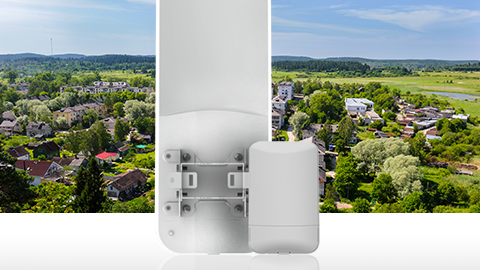
The LigoPTP 6-25 RapidFire shares identical core specifications 700Mbps, 200,000 PPS, 30dBm radio, W-Jet 5 protocol, and IP-67 rating but integrates a 25dBi directional panel antenna. This integrated design eliminates external antenna cables and connectors, reducing signal loss and simplifying installation. The 6-25 is optimal for deployments where the integrated 25dBi gain is sufficient for the required link distance, offering a more cost-effective all-in-one solution compared to the 6-N with separate antenna.
LigoDLB ac Series ?Flexible Point-to-Multipoint
The LigoDLB ac series is designed for point-to-multipoint deployments, video surveillance backhaul, and rural connectivity. These devices feature a 750MHz QCA 9563 CPU, QCA 9882 radio, 64MB RAM, and 16MB flash memory, running the iPoll 3 proprietary protocol optimized for PTMP efficiency. The series integrates 3kV line-to-ground and 1kV line-to-line surge protection.
LigoDLB 6-15ac
The LigoDLB 6-15ac is a compact 6GHz outdoor device with an integrated dual-polarized 15dBi directional panel antenna, delivering 500Mbps+ throughput over the 5.900-6.400GHz band. Recommended distances are 7km in PTP mode and 5km in PTMP mode. The small form factor (158mm x 97mm x 38mm, 185g) with non-metallic IP-65 exterior makes it lightweight and corrosion-resistant. Power consumption is 10W maximum via 24VDC passive PoE.
LigoDLB 6-20ac
The LigoDLB 6-20ac features an integrated dual-polarized 20dBi directional panel antenna, providing approximately 5dB of additional gain over the 6-15ac. It shares the same core specifications (500Mbps+, 30dBm radio, iPoll 3 protocol) with recommended distances of 7km PTP and 4km PTMP. The higher gain translates to roughly 40-50% more range under equivalent link budget conditions.
LigoDLB 5ac Flexible 5GHz Solution
The LigoDLB 5ac operates in the 5.150-5.850GHz band with N-type connectors for external antenna support, providing maximum flexibility for custom antenna configurations. It delivers 500Mbps+ throughput with a 30dBm radio and iPoll 3 protocol, with a maximum PTP distance of 20km (antenna dependent). This model is valuable for mixed-band deployments where 5GHz handles shorter-range connections while 6GHz is reserved for high-capacity backhaul. Visit ligowave-cn.com/ligowave-dlb-6ac for specifications.
Detailed Technical Specifications Comparison
| Specification | LigoPTP 6-N | LigoPTP 6-25 | LigoDLB 6-15ac | LigoDLB 6-20ac | LigoDLB 5ac |
|---|---|---|---|---|---|
| Product Family | LigoPTP RapidFire | LigoPTP RapidFire | LigoDLB ac | LigoDLB ac | LigoDLB ac |
| Deployment Role | PTP Backhaul | PTP Backhaul | PTMP CPE / PTP | PTMP CPE / PTP | PTMP CPE / PTP |
| Frequency Band | 5.900-6.400 GHz | 5.900-6.400 GHz | 5.900-6.400 GHz | 5.900-6.400 GHz | 5.150-5.850 GHz |
| Max Throughput | 700 Mbps | 700 Mbps | 500+ Mbps | 500+ Mbps | 500+ Mbps |
| Packet Processing | 200,000 PPS | 200,000 PPS | Standard | Standard | Standard |
| Radio Output | 30 dBm | 30 dBm | 30 dBm | 30 dBm | 30 dBm |
| Antenna Type | N-Connector | Integrated 25dBi | Integrated 15dBi | Integrated 20dBi | N-Connector |
| PTP Range (Rec.) | Antenna dep. | Antenna dep. | 7 km | 7 km | 20 km (ant. dep.) |
| PTMP Range (Rec.) | N/A | N/A | 5 km | 4 km | Antenna dep. |
| Wireless Protocol | W-Jet 5 | W-Jet 5 | iPoll 3 | iPoll 3 | iPoll 3 |
| WLAN Standard | Proprietary | Proprietary | 802.11a/n/ac, iPoll 3 | 802.11a/n/ac, iPoll 3 | 802.11a/n/ac, iPoll 3 |
| MIMO | 2×2 Dual Pol | 2×2 Dual Pol | 2×2 MIMO | 2×2 MIMO | 2×2 MIMO |
| Channel Width | 5,10,20,40,80 MHz | 5,10,20,40,80 MHz | 5,10,20,40,80 MHz | 5,10,20,40,80 MHz | 5,10,20,40,80 MHz |
| CPU | 1.2 GHz | 1.2 GHz | 750 MHz QCA 9563 | 750 MHz QCA 9563 | 750 MHz QCA 9563 |
| Memory / Flash | Standard | Standard | 64MB / 16MB | 64MB / 16MB | 64MB / 16MB |
| Eth Ports | 2x Gb (1x PoE Out) | 2x Gb (1x PoE Out) | 1x Gb | 1x Gb | 1x Gb |
| Mgmt Radio | 2.4 GHz Internal | 2.4 GHz Internal | None | None | None |
| IP Rating | IP-67 | IP-67 | IP-65 | IP-65 | IP-65 |
| Surge Protection | IEC Class 4 | IEC Class 4 | 3kV/1kV | 3kV/1kV | 3kV/1kV |
| Operating Temp | -40 to 65 C | -40 to 65 C | -40 to 65 C | -40 to 65 C | -40 to 65 C |
| Power Method | PoE 802.3af/at | PoE 802.3af/at | 24VDC Passive PoE | 24VDC Passive PoE | 24VDC Passive PoE |
| Max Power | ~18W | ~18W | 10W | 10W | 10W |
| Cloud Mgmt | Infinity Controller | Infinity Controller | Infinity Controller | Infinity Controller | Infinity Controller |
Model Selection Framework by Deployment Scenario
Scenario-Based Model Selection Matrix
| Deployment Scenario | Distance | Throughput | Recommended Model | Rationale |
|---|---|---|---|---|
| Long-haul PTP backhaul (ISP core) | 10-50+ km | 700 Mbps | LigoPTP 6-N RapidFire | N-connectors enable high-gain parabolic antennas; W-Jet 5 optimizes long-distance PTP |
| Medium-range PTP backhaul | 5-20 km | 700 Mbps | LigoPTP 6-25 RapidFire | Integrated 25dBi antenna simplifies installation; same 700Mbps throughput |
| Video surveillance backhaul | 2-7 km | 500 Mbps | LigoDLB 6-20ac | 20dBi antenna for PTP video; iPoll 3 handles video traffic efficiently |
| PTMP last-mile access | 2-5 km | 500 Mbps/CPE | LigoDLB 6-15ac | Lightweight design; 10W power suits solar deployments |
| 5GHz client bridge | Variable | 500 Mbps | LigoDLB 5ac | External antenna support; backward compatible with iPoll networks |
| Rural connectivity PTMP | 3-5 km | 500 Mbps/sector | LigoDLB 6-15ac/6-20ac | Clean 6GHz spectrum for rural PTMP; iPoll 3 handles multiple CPEs |
| High-security video (repeater) | 5-15 km | 700 Mbps | LigoPTP 6-N RapidFire | Dual Gb ports with PoE passthrough for daisy-chain topologies |
| Industrial IoT backhaul | 1-7 km | 500 Mbps | LigoDLB 6-20ac | 20dBi antenna; IP-65 sufficient for controlled environments |
Step-by-Step Decision Framework
For network engineers evaluating their first LigoWave 6GHz deployment, the following step-by-step decision process incorporates the key variables discussed above:
- Determine topology: If the deployment requires dedicated point-to-point backhaul between two fixed locations, proceed with the LigoPTP RapidFire series evaluation. If multiple remote sites need to connect to a central location (point-to-multipoint), the LigoDLB ac series with iPoll 3 protocol is the appropriate choice.
- Calculate link distance: For PTP links exceeding 10km, select the LigoPTP 6-N with an appropriate high-gain parabolic antenna. For PTP links between 5-20km where integrated antenna gain is sufficient, the LigoPTP 6-25 provides a simpler solution. For PTP links under 7km, the LigoDLB 6-20ac or 6-15ac offers a cost-effective option.
- Assess throughput requirements: Applications requiring sustained throughput above 500Mbps such as aggregating multiple video surveillance streams or serving high-density client populations benefit from the LigoPTP RapidFire series’ 700Mbps capacity. For standard throughput needs up to 500Mbps, the LigoDLB ac series is sufficient.
- Evaluate antenna requirements: When specialized antenna configurations are needed (high-gain parabolic for extreme range, sector antennas for coverage patterns), the N-connector models (LigoPTP 6-N, LigoDLB 5ac) provide maximum flexibility. For standard deployments where an integrated panel antenna meets range requirements, choose the appropriate integrated model based on gain needs.
- Consider environmental factors: Tower-top deployments in exposed locations with extreme weather conditions warrant the IP-67 rated LigoPTP RapidFire series. Less exposed installations can use the IP-65 rated LigoDLB series. For solar-powered remote sites, the LigoDLB series’ 10W power consumption provides a significant advantage.
- Plan for growth: If link capacity requirements are expected to grow over time, selecting the LigoPTP 6-N with an external antenna allows future antenna upgrades without replacing the entire unit. The 6-N’s dual Gigabit Ethernet ports with PoE passthrough also support future daisy-chain topologies for expanding network coverage.
Installation and Configuration Best Practices
Pre-Installation Site Survey
Before deploying any LigoWave wireless bridge, conduct a thorough site survey covering three critical areas. First, GPS coordinates and elevation data for both endpoints should be used to calculate true line-of-sight with Fresnel zone clearance 60% first Fresnel zone clearance is recommended for reliable 6GHz links. Second, spectrum analysis using the device’s built-in site survey tool identifies the cleanest available channels. Third, link budget calculation must account for antenna gain, cable loss (when using external antennas on 6-N or 5ac), and fade margin (minimum 15dB for links under 10km, 20dB+ for longer links).
Antenna Alignment
For the LigoPTP RapidFire series, the integrated 2.4GHz management radio allows installers to connect wirelessly from a smartphone or tablet for initial configuration and antenna alignment a significant advantage at tower-top locations. The management interface provides real-time RSSI and SNR readings for precise alignment. The RGB LEDs on RapidFire models indicate signal strength in 1dBm increments, enabling fine adjustments without referencing a management interface. For LigoDLB series devices, alignment relies on the device’s LED indicators and the LigoWave OS signal strength readings accessible via wired Ethernet connection.
Power and Surge Protection
LigoPTP RapidFire models use standard 802.3af/at PoE (~18W max consumption), while LigoDLB ac models use 24VDC passive PoE (10W max consumption). All models include integrated surge protection RapidFire series meets IEC Class 4 standards; LigoDLB series provides 3kV line-to-ground and 1kV line-to-line protection. For outdoor installations, LigoWave recommends using an external surge protector at the building entry point and ensuring proper grounding of all mounting hardware to a certified grounding rod.
Configuration via LigoWave OS
LigoWave OS provides a consistent management interface across all models. The setup wizard guides users through initial configuration. Single-side configuration (RapidFire models) automatically applies link parameters to the slave device once the master is configured. Key configuration decisions include selecting the appropriate channel width (80MHz recommended for maximum throughput, 40MHz for longer distances or noisy environments), choosing the wireless protocol (W-Jet 5 for LigoPTP, iPoll 3 for LigoDLB), and configuring IP addressing, VLAN tagging, and QoS policies.
Management via Infinity Controller
The Infinity Controller platform provides centralized management across LigoPTP, LigoDLB, and NFT series devices, with automated device onboarding, predefined network scenarios, and real-time performance monitoring. It is particularly valuable for multi-link deployments where centralized firmware management, configuration backup, and alerting are essential for operational efficiency.
Frequently Asked Questions
Q: What is the difference between LigoPTP 6-N and LigoPTP 6-25 RapidFire?
Both models share identical core specifications 700Mbps throughput, 200,000 PPS, 30dBm radio, W-Jet 5 protocol, and IP-67 rating. The key difference is antenna configuration: the 6-N uses N-type connectors for external antennas (flexibility for custom antenna solutions), while the 6-25 integrates a 25dBi directional panel antenna (simpler all-in-one solution). The 6-N suits deployments requiring specialized antennas; the 6-25 is ideal where the integrated 25dBi gain is sufficient. Visit ligowave-cn.com/6g-50km-wireless-bridge for details.
Q: Which models support point-to-multipoint deployments?
The LigoDLB ac series (6-15ac, 6-20ac, 5ac) supports PTMP using iPoll 3 protocol. Recommended PTMP range is up to 5km for the 6-15ac, 4km for the 6-20ac, and antenna-dependent for the 5ac. The LigoPTP RapidFire series is designed for dedicated PTP backhaul using W-Jet 5 protocol. For mixed deployments, LigoWave recommends LigoPTP for backhaul and LigoDLB for access/distribution segments. See ligowave-cn.com/6g-10km-base-station-ptmp for specifications.
Q: What is the maximum range of LigoPTP RapidFire 6-N and 6-25?
The 6-N range is antenna-dependent; with high-gain parabolic antennas, reliable links exceeding 50km have been documented in real-world deployments, including a published case study from Russia. The 6-25 with its integrated 25dBi panel antenna is typically used for medium-range links a published Kazakhstan case study documents a 10.78km link delivering 460Mbps over an 80MHz channel. For specific range planning, use a link budget calculator accounting for antenna gain, cable losses, and fade margin. Visit ligowave-cn.com for case studies.
Q: Can LigoDLB 6-15ac and 6-20ac be used for point-to-point links?
Yes, both support PTP mode with a recommended maximum distance of 7km and 500Mbps throughput. In PTP mode, they serve as cost-effective alternatives to the LigoPTP RapidFire series for shorter-range links. The iPoll 3 protocol performs well in PTP configurations. For links exceeding 7km or requiring throughput above 500Mbps, the LigoPTP RapidFire series with W-Jet 5 protocol is recommended. Specifications are at ligowave-cn.com/6g-10km-base-station-ptmp.
Q: What is the difference between W-Jet 5 and iPoll 3 protocols?
W-Jet 5 is LigoWave’s proprietary protocol engineered for carrier-grade PTP scenarios, minimizing interference and stabilizing latency over long-distance links. It is used exclusively in the LigoPTP RapidFire series. iPoll 3 is optimized for PTMP deployments, using a polling mechanism where the base station polls connected CPE devices to manage airtime allocation and ensure fairness across multiple clients. It is used in the LigoDLB ac series. Both protocols are backward-compatible with previous LigoWave device generations.
References
- LigoWave Official Website ligowave-cn.com
- LigoPTP RapidFire Series —ligowave-cn.com/6g-50km-wireless-bridge
- LigoDLB Series —ligowave-cn.com/6g-10km-base-station-ptmp
- LigoDLB 6-15ac —ligowave-cn.com/ligodlb-6-15ac
- LigoDLB 6-20ac —ligowave-cn.com/6g-10km-cpe-ptp
- LigoDLB 5ac —ligowave-cn.com/ligowave-dlb-6ac
- LigoPTP 6-25 Kazakhstan Case Study LigoWave Official Case Studies
- LigoPTP 6-N Russia Case Study LigoWave Official Case Studies