5GHz EOL Replacement Guide | Ubiquiti, Cambium & MikroTik Status + LigoWave Options
The Complete Guide to Replacing Discontinued 5 GHz Wireless Gear: Official Status Lists and LigoWave Alternatives
At a Glance
Who this is for: network engineers maintaining Ubiquiti airMAX, Cambium ePMP or MikroTik 5 GHz sites, ISP and private-network operations leads, and integrators scoping a replacement project.
The problem: the three largest sources of installed 5 GHz hardware have each entered an officially announced end-of-life phase — “Discontinued” and “Legacy” tiers at Ubiquiti, dated EOS/EOL notices at Cambium, and “Discontinued” flags at MikroTik — yet none of them publishes a cross-brand, model-by-model replacement reference.
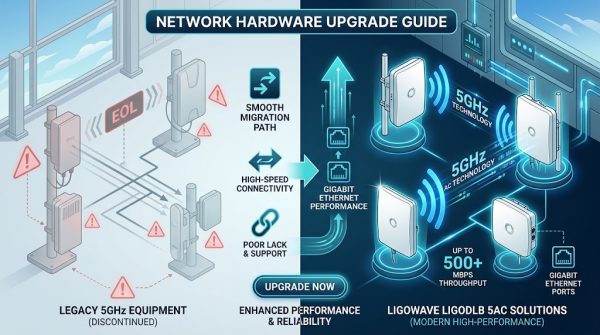
The conclusion: as of September 2026, Ubiquiti’s official list places the NS5 and Loco5 in “Discontinued” status and the RM5 / BM5 / PBE-M5-620 / airGrid families in “Legacy”; Cambium’s Force 190, Force 200 5 GHz and ePMP 1000 have passed EOL; MikroTik marks the SXT 5 AC and DynaDish 5 as Discontinued. The LigoWave LigoDLB 5ac family — gigabit Ethernet, 500+ Mbps, iPoll 3 and 24 V passive PoE — provides a model-by-model substitution path. The 25–29 dBi long-range dish tier has no all-in-one equivalent and requires an external antenna; we say so plainly below.
Where 5 GHz Hardware Stands in 2026
Many networks were built between 2015 and 2020, with base stations and CPE drawn from Ubiquiti, Cambium or MikroTik. All three 5 GHz portfolios are now in the late stage of their published lifecycles, but each vendor frames retirement differently: Ubiquiti uses a two-tier “Legacy / Discontinued” scheme, Cambium publishes specific EOS and EOL dates, and MikroTik simply flags a product as Discontinued on its product page.
The table below summarizes all three vendors’ official positions (verified September 2026; every entry can be re-checked on the vendor’s own site):
Official Status Overview Across the Three Vendors
| Vendor | Official framing | Representative 5 GHz models | Stated reason | Power after moving to LigoDLB |
|---|---|---|---|---|
| Ubiquiti | Official “Legacy and Discontinued Products” list, two status tiers | NS5, Loco5 (Discontinued); RM5-Ti / RM5-GPS, BM5-Ti / BulletM5-HP, PBM5 / PBM10, PBE-M5-620, PBE-5AC series, the full airGrid line, LBE-5AC-23, NB-5G22 / NB-5G25, NS-5ACL (Legacy) | Yes (general statement) | Identical (24 V passive) |
| Cambium | EOS / EOL dates published on the official Product Lifecycle page | ePMP 1000, Force 190, Force 200 5 GHz (End of Life); Force 180, Force 300-19, Force 300 CSM, ePMP 3000 (End of Sale) | Yes (generic reason on the policy page) | Requires a 24 V injector (originally 802.3af/at) |
| MikroTik | “Discontinued” flag on the product page | SXT 5 AC, DynaDish 5, SXT Lite5 | None stated | The SXT 5 AC accepts 24 V input; most injectors can stay |
All three vendors’ official replacement paths point to their own next-generation products — Cambium even publishes a same-brand “Recommended Replacement” list — and none offers guidance on reusing existing antenna systems or bringing in a second supplier.
Official Retirement Reasons and Status Definitions
Every status and reason that goes into a replacement plan should be traceable to the vendor’s own wording. The quotes below are verbatim from the official pages (Chinese-language originals where the vendor publishes a Chinese page, English otherwise).
Cambium Networks (reason stated officially)
Cambium’s other official phrasing: “we periodically transition away from selling or servicing certain hardware or software products to focus on innovation in bringing exciting new products to the market.” (Source: the official Product Lifecycle page)
One official rule worth noting: fixed wireless products reach End of Life four years after End of Sale. That means a known EOS date lets you predict the support cutoff — for example Force 190 (EOS 2021-11-03 → EOL 2025-11-03) and Force 180 (EOS 2025-03-31 → EOL 2029-01-31).
Ubiquiti (official Help Center, two tiers)
Ubiquiti’s general statement on retirement (verbatim): “Ubiquiti is committed to product innovation and to providing customers with excellent technical support, which means that sometimes discontinued products will no longer receive technical support.” The company also commits that “all Ubiquiti products sold will continue to be covered under warranty for their warranty period or as required by law.”
MikroTik (no reason stated officially)
On product pages such as the SXT 5 AC and DynaDish 5, MikroTik marks only “Discontinued” — no stated reason and no pointer to a successor. Rather than guess at vendor intent, we note only that rising component costs may also be a factor. One more quotable line from the official product pages: “New products are backwards compatible — for example, you can replace your 5GHz 802.11an legacy Access Point with a new 802.11ac product and your existing customers will still be able to connect to it.” That matters for phased migrations: during the transition you can run mixed traffic in standard 802.11 mode.
Discontinued Model → LigoWave Quick-Reference Table
One-Page Reference (5 GHz SKUs with Published End-of-Life Status)
| Discontinued / retired model (brand + official status) | Recommended LigoWave model | Verdict | Reason in one line |
|---|---|---|---|
| MikroTik SXT 5 AC (Discontinued) | LigoDLB 5-15ac | Full replacement | Gain 16 → 15 dBi, a 1 dB difference; gigabit port, 500+ Mbps, dual-polarization upgrade |
| MikroTik SXT Lite5 (Discontinued) | LigoDLB 5-15ac | Full replacement | 802.11a/n with a Fast Ethernet port → 802.11ac with gigabit; a generational upgrade |
| MikroTik DynaDish 5 (Discontinued, 25 dBi dish) | LigoDLB 5-20ac (≤8 km) / 5ac + dish antenna | Partial replacement | 5 dB short as an all-in-one; long links need an external antenna |
| Cambium Force 180 / 190 (End of Sale / EOL) | LigoDLB 5-15ac / 5-20ac | Full replacement | Gain and form factor line up; throughput and interface improve |
| Cambium Force 200 5 GHz (EOL, 25 dBi dish) | LigoDLB 5-20ac / 5ac + dish | Partial replacement | 5 dB gain difference; verify against link margin |
| Cambium Force 300 CSM (End of Sale, connectorized) | LigoDLB 5ac | Full replacement | Both are 2×N connectorized; existing antenna feed can be reused |
| Cambium ePMP 1000 / 2000 AP (End of Sale / EOL) | LigoDLB 5-90AC | Partial replacement | Base-station architecture change; sector capacity must be recalculated |
| Ubiquiti NS5 / Loco5 (Discontinued) | LigoDLB 5-15ac | Full replacement | Officially Discontinued (no security updates); 802.11a → ac, Fast Ethernet → gigabit |
| Ubiquiti RM5-Ti / RM5-GPS / R5AC series (Legacy) | LigoDLB 5ac | Full replacement | Both are connectorized platforms; the antenna feed can be reused |
| Ubiquiti BM5-Ti / BulletM5-HP (Legacy) | LigoDLB 5ac | Full replacement | Both are connectorized platforms |
| Ubiquiti R5AC-PTMP / PS-5AC-45 (Legacy) | LigoDLB 5-90AC | Full replacement | 90° sector form factor matches; wider elevation (20° vs roughly 4°) |
| Ubiquiti PBE-M5-620 / NB-5G22 / NB-5G25 / airGrid (Legacy) | LigoDLB 5ac + high-gain antenna | No all-in-one match | Originally 22–29 dBi high-gain; LigoWave all-in-one tops out at 20 dBi, so an external antenna is required |
For the detailed matching logic, spec comparisons and scenario notes, see “In-Depth Guides by Brand” below.
A Three-Step Decision Tree for Choosing a Replacement
Choosing a replacement does not require a complicated case. Three steps will do:
Brand by Brand: Nine Dimensions Beyond the Datasheet
These three vendors differ widely in installed-base status, power conventions and protocol ecosystems — forcing all three into one table obscures the real accounting for each. So we split them into three, each answering a single question: for a site on this brand, what changes, what is saved, and what needs attention when moving to LigoWave? In real replacement projects, these nine dimensions often weigh as heavily as the RF specs themselves.
1. Ubiquiti airMAX sites → LigoWave LigoDLB
Ubiquiti sites are the lightest lift of the three: official status has already moved into “Legacy / Discontinued,” yet the power convention matches LigoWave exactly and the antenna form factors line up closely.
| Dimension | Ubiquiti airMAX (installed) | LigoWave LigoDLB (replacement) | Advantage / trade-off |
|---|---|---|---|
| Wireless protocol | airMAX proprietary TDMA; AC and M generations are not interoperable either | iPoll 3 proprietary TDMA (not interoperable with airMAX) | Whole sites must switch generation together; but iPoll 3 runs mixed within a sector, which helps with staged cutover |
| Power convention | Primarily 24 V passive PoE | 24 V passive PoE (max 10 W) | Identical — injectors and pinout can be reused as is |
| Power rework | — | — | Zero rework — the only plug-and-play power relationship among the three |
| Throughput / interface | Mostly Fast Ethernet (NS5 / Loco5 / airGrid); some AC models are gigabit | 10/100/1000 across the line, 256-QAM with FEC/LDPC, 500+ Mbps | Most positions move from Fast Ethernet to gigabit, a generational throughput step up |
| Antenna form factor and gain | Integrated CPE (NS5, PowerBeam) and connectorized (Rocket, Bullet) coexist; high-gain tier 22–29 dBi | 5-15ac (15 dBi) / 5-20ac (20 dBi) integrated CPE; 5ac (2×N) connectorized; 5-90AC sector | ≤20 dBi models match form factor and gain directly; the 22–29 dBi tier has no all-in-one match and needs a 5ac with an external antenna |
| Central management | UISP | WNMS (manages the 5ac / 6 series and sector base stations together) | Management must be rebuilt, but one platform then covers future 6 GHz gear as well |
| Lifecycle status | Two tiers: Legacy / Discontinued; Discontinued models get no feature or security updates | In production, actively maintained with firmware updates | Out of the “no security updates” state — assets can return to compliant lifecycle management |
| 6 GHz path | The airMAX line has no 6 GHz fixed-wireless model | The LigoDLB 6 series, same platform, protocol and management as the 5ac | A continuous upgrade path; moving to 6 GHz later needs no change of manager or protocol stack |
| Model-level evidence | Official list names only the family (airMAX) with no cross-brand guidance | Per-SKU matching table plus link-based verdicts (this article’s quick reference and the Ubiquiti guide) | Selections are defensible, cutting repeated proof work site by site |
Bottom line: for Ubiquiti sites moving to LigoWave, the core strengths are zero power rework plus form-factor matching, which makes migration the least disruptive of the three. The one exception worth separate analysis is the original 22–29 dBi high-gain tier (PowerBeam / NanoBeam / airGrid): LigoWave all-in-ones top out at 20 dBi, so those positions need a 5ac reusing the original antenna, or a step down to a lower-gain model with the link margin re-verified.
2. Cambium ePMP sites → LigoWave LigoDLB
Cambium is the most formally retired and the most time-pressured of the three: EOS / EOL dates are published, and fixed wireless products reach end of life four years after EOS. The main cost of switching to LigoWave is the change in power convention.
| Dimension | Cambium ePMP (installed) | LigoWave LigoDLB (replacement) | Advantage / trade-off |
|---|---|---|---|
| Wireless protocol | ePTP / TDD proprietary (not interoperable with LigoWave) | iPoll 3 proprietary TDMA | Whole-site replacement required; TDD uplink scheduling is comparable and suits uplink-heavy traffic |
| Power convention | 802.3af/at (standard 48 V PoE) | 24 V passive PoE (max 10 W) | Different convention — the primary rework point for this brand |
| Power rework | — | — | Insert a 24 V passive injector on the device side (or reconfigure the switch port), once per site |
| Throughput / interface | ePMP 1000 mostly Fast Ethernet; Force 300 series gigabit | 10/100/1000 across the line, 500+ Mbps | Interface and throughput generally improve, especially ePMP 1000 → gigabit |
| Antenna form factor and gain | Force 180 / 190 (integrated CPE), Force 200 (25 dBi dish), Force 300 CSM (connectorized) | 5-15ac / 5-20ac integrated CPE; 5ac connectorized; 5-90AC sector | Force 180/190/CSM match form factor; Force 200 (25 dBi) has no all-in-one match, a 5 dB shortfall requiring a 5ac with a dish antenna |
| Central management | cnMaestro (cloud / on-premises) | WNMS | Management migration means re-onboarding; WNMS then covers both the 5ac and the future 6 series |
| Lifecycle status | EOS / EOL dates published; support cutoff can be worked out in advance | In production, actively maintained with firmware updates | Replacement removes the “EOL, unsupported” compliance risk and gives a clear maintenance window to plan around |
| 6 GHz path | Has ePMP 4600 / Force 4600 series (subject to AFC authorization) | The LigoDLB 6 series (same platform as the 5ac) | Both can move to 6 GHz; LigoWave’s edge is reusing the same manager and protocol stack from 5 to 6 GHz |
| Model-level evidence | Vendor gives a same-brand Recommended Replacement list (not cross-brand) | Per-SKU matching table plus link-based verdicts (this article’s quick reference and the Cambium guide) | This article fills the cross-brand gap the vendor leaves open |
Bottom line: for Cambium sites, the greatest value of moving to LigoWave is securing a manageable replacement path before the official EOL date. The main work sits in power rework (48 V → 24 V passive injector) and management migration. The 25 dBi dish positions such as the Force 200 likewise have no all-in-one match and need to be assessed against link margin.
3. MikroTik sites → LigoWave LigoDLB
MikroTik marks products only as Discontinued — no reason, no successor — so selection here needs external evidence most of all. On the other hand, its power flexibility means most sites need little rework.
| Dimension | MikroTik (installed) | LigoWave LigoDLB (replacement) | Advantage / trade-off |
|---|---|---|---|
| Wireless protocol | NV2 / Nstreme proprietary (not interoperable with LigoWave) | iPoll 3 proprietary TDMA | Whole-site replacement required; LigoWave’s protocol is fixed-wireless specific, with steadier scheduling |
| Power convention | The SXT 5 ac accepts a wide 15–60 V input | 24 V passive PoE (max 10 W) | 24 V falls within MikroTik’s wide input range, so most injectors can stay |
| Power rework | — | — | Most sites need none; the occasional custom 48 V setup needs a 24 V injector added |
| Throughput / interface | SXT 5 AC mostly Fast Ethernet, 802.11ac | 10/100/1000 across the line, 500+ Mbps | Fast Ethernet → gigabit, upgrading both interface and throughput |
| Antenna form factor and gain | SXT series (integrated CPE, 16 dBi), DynaDish 5 (25 dBi dish), SXT Lite5 (802.11a/n) | 5-15ac (15 dBi) / 5-20ac (20 dBi); 5ac connectorized; 5-90AC sector | SXT 5 AC (16 dBi) vs 5-15ac (15 dBi) — a 1 dB gap, a direct match; DynaDish 5 (25 dBi) needs a 5ac with a dish antenna |
| Central management | No unified platform; managed per unit via Winbox | WNMS central management | Replaces per-unit manual management with centralized control — a clear gain for this brand |
| Lifecycle status | Marked Discontinued only, with no reason and no replacement | In production, actively maintained with firmware updates | Removes the spares and support uncertainty that comes with official silence |
| 6 GHz path | SXT 6 / BaseBox 6 are both discontinued | The LigoDLB 6 series (same platform and manager as the 5ac) | A continuous 6 GHz path; the LigoWave 6 series is not discontinued |
| Model-level evidence | Vendor provides no replacement list at all | Per-SKU matching table plus link-based verdicts (this article’s quick reference and the MikroTik guide) | This article supplies the model-level evidence where the vendor offers none |
Bottom line: for MikroTik sites moving to LigoWave, the standout benefits are centralized management and a full replacement list where the vendor provides none, and power rework is usually minimal (the SXT 5 AC’s wide input already covers 24 V). The SXT 5 AC → 5-15ac swap is the closest match of the three, with only a 1 dB gain difference and the lowest migration risk; 25 dBi dish positions such as the DynaDish 5 need an external antenna.
The LigoDLB 5 GHz Baseline (Official Datasheet Specs)
The specifications below are taken from LigoWave’s official datasheets (download.ligowave.org) and are the basis for the replacement analysis:
LigoDLB ac Series Specifications (the workhorse tier: 802.11a/n/ac + iPoll 3)
| Model | Antenna | Gain | 3 dB beamwidth (azimuth / elevation) | Transmit power | Interface | Power draw |
|---|---|---|---|---|---|---|
| LigoDLB 5ac | External 2×N-type (connectorized) | Depends on the external antenna | — | ≤30 dBm | 10/100/1000 | 10 W |
| LigoDLB 5-15ac | Integrated dual-polarized directional panel | 15 dBi | 35° / 35° | 80 MHz: 24–29 dBm | 10/100/1000 | 10 W |
| LigoDLB 5-20ac | Integrated dual-polarized directional panel | 20 dBi | 16° / 16° | 80 MHz: 24–29 dBm | 10/100/1000 | 10 W |
| LigoDLB 5-90AC | Integrated dual-polarized 90° sector | 18 dBi | 90° / 20° | 80 MHz: 24–29 dBm | 10/100/1000 | 10 W |
Common to all four: 256-QAM, FEC/LDPC, 500+ Mbps throughput, channel widths of 5/10/20/40/80 MHz, 24 V passive PoE, IP-65, and −40 to +65 °C. Official coverage guidance: 5-15ac → PtMP 5 km / PtP 7 km; 5-20ac → PtMP 10 km / PtP 15 km. The hardware platform is a QCA9563 (750 MHz) with a QCA9882, 64 MB RAM and 16 MB flash.
Migration Checklist and Implementation Phases
Calculate First: Link-Budget Shortcut
Whenever gain or transmit power changes after the swap, work out the received signal level (RSL) before deciding on a model. Two formulas cover it:
RSL(dBm) = PTX + GTX antenna + GRX antenna − FSPL − cable and connector loss
At 5.8 GHz, these are the FSPL figures worth remembering for common distances:
| Link distance | 5 km | 10 km | 15 km | 20 km |
|---|---|---|---|---|
| FSPL @ 5.8 GHz | ≈ 121.7 dB | ≈ 127.7 dB | ≈ 131.2 dB | ≈ 133.8 dB |
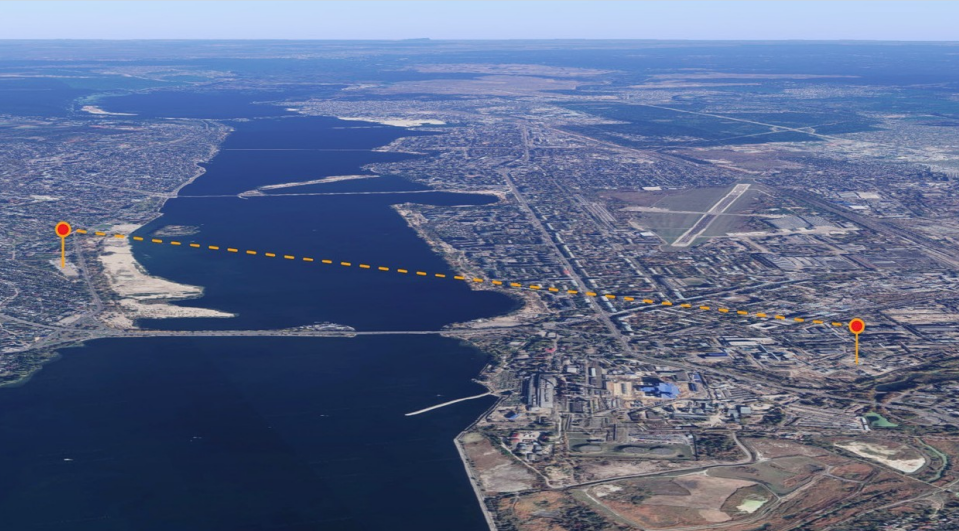
Once you have the RSL, compare it with the receiver sensitivity of the target model at 80 MHz (the LigoDLB 5ac family ranges from −64 to −90 dBm) and keep at least 10 dB of margin (add another 5–10 dB for rain fade in wet regions). If margin is short, drop the channel width to 40 MHz or move to a higher-gain antenna. Full worked examples per model (including airMAX sectors and the long-range PBE-620 link) appear in the individual brand guides.
Per-Site Checklist
| Item | What to confirm |
|---|---|
| Band and regulation | Confirm locally available 5 GHz channels and the EIRP limit |
| Gain and beam | When gain differs by more than 5 dB or the beam shape varies significantly, recalculate both link budget and coverage angle |
| Link-budget review | When gain or power changes, recalculate RSL using the FSPL formula; keep ≥10 dB margin (plus rain fade in wet regions) |
| Beamwidth convention | Ubiquiti sectors are specified at 6 dB and LigoWave at 3 dB; similar figures do not mean equivalent coverage, so re-check sector overlap against the radiation pattern |
| Port speed | After moving from Fast Ethernet to gigabit, confirm the uplink device and cabling (Cat5e or better) are up to it |
| Power method | 24 V passive PoE throughout; verify the injector or switch — 48 V cannot be connected directly |
| Protocol compatibility | iPoll 3 is proprietary and must be replaced in pairs; Ubiquiti’s own airMAX ac and M generations also cannot mix in airMAX mode |
| Environmental rating | IP-65 / −40 to 65 °C |
| Management | Bring everything into WNMS for templated configuration and bulk upgrades |
| Mounting compatibility | Pole diameter, downtilt, antenna orientation; on connectorized sites, confirm the N-type connectors and cable condition |
| Rollback plan | Keep old hardware and config backups on hand, sealed and labelled, so a pilot window that underperforms can be reverted quickly |
Six Implementation Phases (with Exit Criteria)
This table is the shared process skeleton for all three in-depth guides. Each phase has clear outputs and exit criteria. Networks of ten sites or fewer can merge phases two and three; networks of a hundred sites or more should follow the order strictly.
| Phase | Key actions | Exit criteria |
|---|---|---|
| 1. Asset inventory | Export the register: model / official status / wireless mode / frequency and bandwidth / antenna form factor and gain / link distance / power method / whether it also routes / traffic class | Every link fully recorded; “EOL / Discontinued” and “also routes” flagged separately |
| 2. Link-budget review | Calculate RSL link by link using the FSPL formula; choose the model from gain difference and distance (CPE → 5-15ac / 5-20ac; connectorized → 5ac; sector → 5-90AC) | Every site has a definite model, an antenna plan (keep / buy new / reuse) and a power-rework verdict |
| 3. Staging and pre-configuration | Pack materials per site; pre-load frequency, bandwidth, power, IP, VLAN and iPoll 3 from WNMS templates in the warehouse, flashing and labelling each unit | Every unit passes self-test, config matches the register, labels map one-to-one to sites |
| 4. Pilot validation | Replace one typical link and one long-distance link first; record signal, throughput and latency before and after; prepare a rollback plan | The pilot link runs stably for 72 hours, the full checklist passes, and a standard runbook is produced |
| 5. Bulk migration | Prioritize EOL / Discontinued sites; cap each batch at one week of work for a single operations team; leave a week of observation between batches; switch link by link, in pairs | All target sites switched and stable for two weeks, with no unresolved rollbacks |
| 6. Close-out | Clear configurations and decommission old assets; warehouse sound antennas and dishes as spares; archive baseline comparisons and runbooks; hand over WNMS alerts and spare-stock levels | Documentation closed out; spare-stock level set at 3–5% of site count |
In-Depth Guides by Brand
- MikroTik 5 GHz Discontinued Replacement Guide — verifying the official Discontinued status of the SXT 5 AC, DynaDish 5 and SXT Lite5, with model-by-model matching
- Cambium ePMP 5 GHz EOL Replacement Guide — the EOS/EOL timeline, official reasons and replacement options for Force 180 / 190 / 200 and ePMP 1000 / 2000
- Ubiquiti airMAX Legacy / Discontinued List and Replacement Guide — status verification and matching for the NS5 / Loco5 / Rocket M / Bullet M / PowerBeam / airGrid families
References
- Ubiquiti Help Center, “Legacy and Discontinued Products”: help.ui.com.cn/hc/zh-cn/articles/1500001268521
- Cambium Networks, “Product End-of-Life Policy”: cambiumnetworks.com/eol
- Cambium Networks, “Product Lifecycle”: cambiumnetworks.com/support/product-lifecycle
- MikroTik product pages (SXT 5 AC / DynaDish 5, marked Discontinued): mikrotik.com/product/RBSXTG-5HPacDr2
- LigoWave official datasheet downloads: download.ligowave.org
All end-of-life statuses and official dates were verified on 2026-09-14. Vendor policies can change, so re-check the latest official pages before publication or bidding.
Frequently Asked Questions
Q: Can I keep using 5 GHz hardware after it is discontinued?
It depends on the vendor’s tier. Ubiquiti “Legacy” products can still be purchased and receive technical support, including critical bug fixes and security updates; “Discontinued” products such as the NS5 and Loco5 get no feature or security updates by the vendor’s own statement. For Cambium products past EOL (such as the Force 190 and ePMP 1000), the vendor no longer provides technical, software or hardware support. Running them is not a compliance violation, but there is no official repair channel if they fail — a known operational risk.
Q: Can LigoDLB’s iPoll 3 interoperate with airMAX or ePMP?
No. iPoll 3 is LigoWave’s proprietary TDMA protocol and does not interoperate with Ubiquiti airMAX or Cambium ePMP, so replacements must be done in pairs. During the transition you can run mixed traffic in standard 802.11 mode — MikroTik’s own product pages note that 802.11ac products are backwards compatible with legacy 802.11an devices, so phased replacement has official backing.
Q: Can existing 24 V PoE injectors be reused?
On Ubiquiti airMAX and most MikroTik sites, yes: the entire LigoDLB line runs on 24 V passive PoE, matching the airMAX convention, so injectors can be reused directly. Cambium sites are typically 802.3af/at, so they need the 24 V injector supplied with LigoDLB — a low-cost change, but one that belongs in the budget.
Q: How do I replace a long-range dish link above 25 dBi?
To be straightforward about it: LigoDLB all-in-ones top out at 20 dBi, so there is no matching product for the 25–29 dBi tier. For links of 8 km or less, you can evaluate the 5-20ac with the gain difference checked against margin; for longer links we recommend the LigoDLB 5ac (connectorized) reusing the original dish antenna — keeping the antenna system and swapping only the radio.
Q: When must a replacement project start?
There are three hard triggers under the official rules: the hardware has passed EOL (Cambium’s fixed wireless products reach end of life four years after EOS), the vendor has flagged it as Discontinued (no feature or security updates), or capacity purchases can no longer be sourced through official channels. Meeting any one of these should put those sites on the replacement schedule.