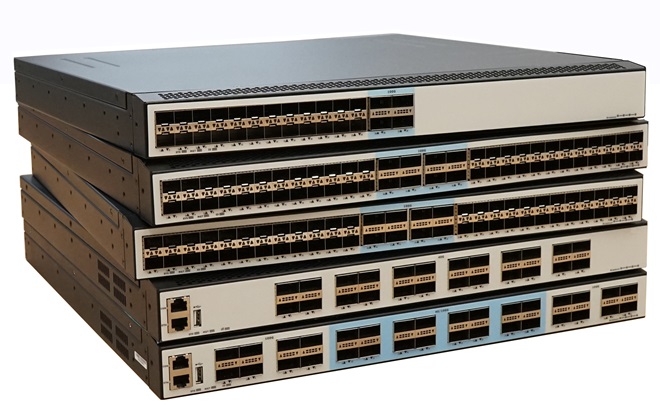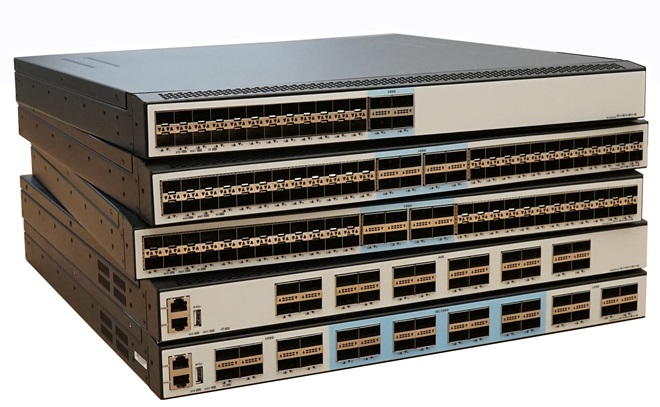
V682-TAP Ethernet Switch Supports multiple ports including 10G/25G/40G/100G.
The Centec V682-TAP(Test Access Port) Series Switches are TAP switches to meet network requirements for traffic analysis and traffic monitoring. V682 TAP switch supports flexible features of traffic aggregation /filtering /editing/ distributing with chipset CTC8180. V682-TAP switch comes with Centec’s CNOS based system software that supports various TAP functions, including M: N, symmetrical HASH, time stamps and packet truncation. The system supports multiple management mechanism for rapid and flexible service deployment. The V682-TAP Series Switches currently include these configurations: V682-32C-TAP, V682-48Y8C-TAP, V682-48X8C-TAP, V682-24Y4C-TAP, V682-24Q-TAP.
Introduction
The Centec V682-TAP(Test Access Port) Series Switches are TAP switches to meet network requirements for traffic analysis and traffic monitoring.
V682 TAP switch supports flexible features of traffic aggregation /filtering /editing/ distributing with chipset CTC8180.
V682-TAP switch comes with Centec’s CNOS based system software that supports various TAP functions, including M: N, symmetrical HASH, time stamps and packet truncation. The system supports multiple management mechanism for rapid and flexible service deployment.
The V682-TAP Series Switches currently include these configurations: V682-32C-TAP, V682-48Y8C-TAP, V682-48X8C-TAP, V682-24Y4C-TAP, V682-24Q-TAP.
Product Characteristic
Higlights
* Provide 10G/25G/40G/100G ports
* Standard 1RU pizza-box solution
* Up to 6.4Tbps switching capacity
* Cut-Through switching mode
* Flow aggregation / duplication/ distribution
* Support packet truncation
* Support IPinIP/MPLS/GTP/ PPPOE decapsulation
* Support GRE/NVGRE/VxLAN/ERSPAN encapsulation and decapsulation
* Support M:N traffic aggregation and replication.
* Support Ingress and Egress filter.
* Support time stamping and source port labeling
* Support UDF matching
* Support UDF tunneling termination
* Support IPFIX
System Design for Green and Energy Saving
* Intelligent FAN adjustment and real-time power consumption monitoring technology are provided for the cost of maintenance redundancy and help to build a green and energy saving network.
Hardware specification
| Items | V682 -32C -TAP | V682 -24Q -TAP | V682 -48Y8C -TAP | V682 -48X8C -TAP | V682 -24Y4C -TAP | |
| Size (H×W×D) | 4.4 x 44.2 x 47.1 cm (1.73 x 17.4 x 18.54 in.) | 4.4 x 44.2 x 45.1 cm (1.73 x 17.4 x 17.75 in.) | ||||
| Weight | 9.00KG | 9.20KG | 9.05KG | 9.05KG | 8.355KG | |
| RS-232 Serial Ports | 1 RJ-45 port located at the left side of front panel | 1 RJ-45 port located at the left side of rear panel | ||||
| Management Ports | 1 RJ-45 out-of-band management port located at the left side of front panel | 1 RJ-45 out-of-band management port located at the left side of rear panel | ||||
| USB Ports | 1 Type-A USB port located at the left side of front panel | 1 Type-A USB port located at the left side of Rear panel | ||||
Performance specifications
| Performance | V682-32C | V682-24Q | V682-48Y8C | V682-48X8C | V682-24Y4C | |
| Line speed forwarding | Switch capability | 6.4 Tbps | 1.92 Tbps | 4 Tbps | 2.56 Tbps | 2 Tbps |
| Throughput | 3571.20 Mpps | 1428.48 Mpps | 2976.00 Mpps | 1904.64 Mpps | 1488.00 Mpps | |
Software Features
| Feature | Description | |
| Basic | Basic functions | Support M:N copy mode(from M source ports to N destiation ports) |
| Support ACL actions: copy/forwding/discarding | ||
| Support Ingress and Egress ACL matching The L2,L3,L4,TCP/IP quintuple | ||
| Support VxLAN and GRE. Support matching The Inner L2,L3,L4,TCP/IP quintuple | ||
| Support matching ERSPAN ID | ||
| Support matching PBB packets | ||
| Support matching UDF(User defined field) | ||
| Support matching the IPv6 SA, IPv6 DA and flow-label | ||
| Support matching The Inner IPv6 SA, IPv6 DA and flow-label | ||
| Support link aggration port to be a TAP ingress port or egress port | ||
| Support timestamp based on local time | ||
| Support stripping or editing the VLAN Tag | ||
| Support editing MACSA and MACDA | ||
| Support editing IPSA and IPDA | ||
| Support editing IPv6SA and IPv6DA | ||
| Support editing TAP/UDP Port | ||
| Support truncating the packets | ||
| Support making a copy of the flow | ||
| Support GRE decapsulation/encapsulation | ||
| Support NvGRE decapsulation/encapsulation | ||
| Support IPinIP decapsulation | ||
| Support VxLAN decapsulation/encapsulation | ||
| Support ERSPAN decapsulation/encapsulation | ||
| Support MPLS decapsulation | ||
| Support Geneve decapsulation | ||
| Support PPPOE decapsulation | ||
| Support GTP decapsulation | ||
| Support defined field to strip | ||
| Support traffic masking | ||
| Support LLDP | ||
| Support packet capture | ||
| Load balance | Support using HASH by session | |
| Support using HASH by TCP/IP quintuple. | ||
| Support using HASH by VxLAN, GRE/NvGRE inner MAC/IP | ||
| Support using HASH by UDF | ||
| Support using HASH by MAC address | ||
| Support select HASH key by ingress port | ||
| Support Self-healing | ||
| Management | Management interface | Support 4 level privilege control of CLI |
| Support console management | ||
| Support Telnet management | ||
| Support SSH management | ||
| Support WebUI management | ||
| Support SNMP Get | ||
| Support SNMP Trap | ||
| Support Open API | ||
| Security | Support TACAS+ | |
| Support RADIUS | ||
| Support local username and password | ||
| Support login-security | ||
| Support DDOS prevent | ||
| Support Telnet/SSH ACL filtering | ||
| System management | Support directory and document management | |
| Support upload and download files via TFTP/FTP/WEBUI | ||
| Support different system images based on same Uboot | ||
| Network diagnostics | Support Ping | |
| Support Traceroute | ||
| Log & alarm | Support CPU usage display and alarm | |
| Support Memory usage display and alarm | ||
| Support CPU/Memory histroy log display | ||
| Support Device temperature、PSU、FAN status display and alarm | ||
| Support User operation logs | ||
| Support Management of logs, alarms, and debugging information | ||
| Support Interface bandwidth usage display and alarm | ||
| Reboot | Support manual reboot | |
| Support schedule Reboot | ||
| Support reboot Information logging | ||
| System time | Support time configuration | |
| Support Timezone | ||
| Applications | Support NTP | |
| Support Syslog and Log Server | ||
| Support debugging | ||
| Support Sflow | ||
| Support ipfix | ||
| Support telnet client | ||
| Support IPv6 at management interface | ||
| Support format flash and flash:/boot | ||
| Support reset factory-config | ||
| Support md5sum | ||
| Support Banner configuration | ||
| Support HTTPS certificate load | ||
| Plantform | Interface | Support duplex full/half/auto |
| Support store-and-forward forward mode | ||
| Support cut-through forward mode | ||
| Support Ingress crc-check | ||
| Support Egress crc-recalculation | ||
| Support 100G/40G hybrid Support split one 40G port into 4 * 10G ports Support split one 100G port into 4 * 25G ports | ||
| Support maxinum frame size 16127B | ||
| Support unidiretional. Support transmit only or receive only. | ||
| Support set errdisable detection and recovery | ||
Applications
Traffic Monitoring Application
In traditional network applications, TAP devices are used to sample egress traffic flow. With the expansion of network scale, there is growing requirement in deeper performance monitoring. The high performance TAP devices can be used for such application.
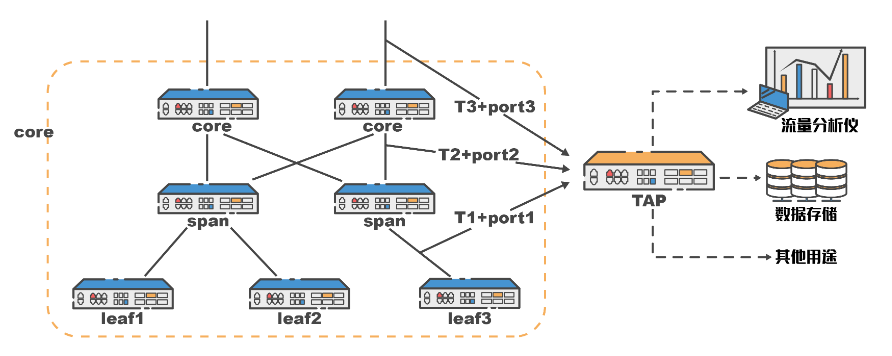
Figure 1: Traffic Monitoring Application
As shown in figure above, user can enable the timestamp and source port label function of TAP devices, the server cluster can access the exact packet process time in each layer via source port and timestamp message carried by the packets. From port1, port2, port3, user can distinguish the devices that the streams come from. Through T1, T2 and T3, packets forward latency of each device can be calculated, according to that, user can find out the bottleneck during packet forwarding for the further optimization of network.
DPI Applications
Generally, TAP devices can be used to assist DPI (Deep Packet Inspection) in networks. TAP is applied to forward flows to intranet and sends a mirrored copy of the packet flow to DPI device at the same time. The DPI device is for traffic analysis, once a virus on website or illegal information has been monitored, the flows will be blocked by a five elements table sent from management channel between DPI and TAP.
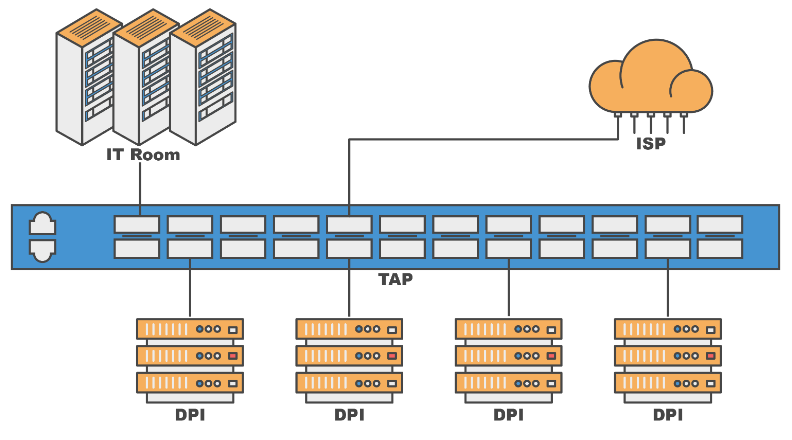
Figure 2: DPI Application